In collaboration between UCL (The Bartlett), the International Hellenic University, and Pontificia Universidad Católica de Chile, this work introduces a new methodology for assessing bridge portfolios under seismic hazard.
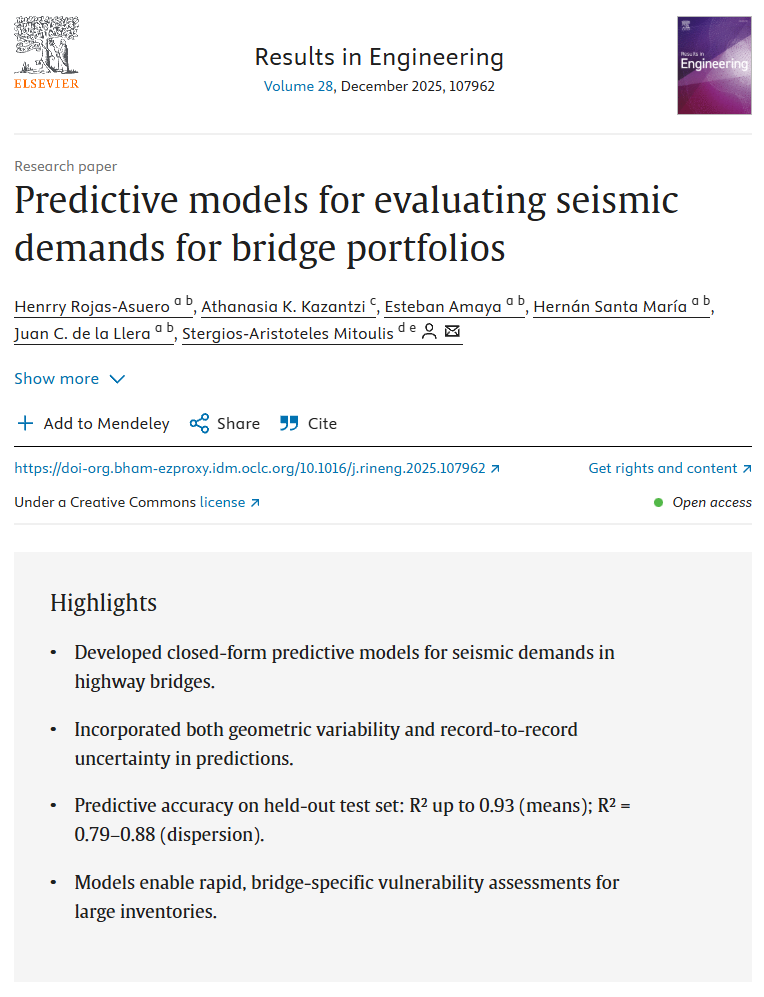
Key contribution
While seismic intensity is commonly used as the dominant parameter for structural demand, this paper demonstrates that earthquakes with the same intensity level can lead to dramatically different structural responses. This is due to variations in:
- Frequency content
- Duration
- Spectral characteristics of ground motion
This record-to-record variability represents a major source of aleatory uncertainty in seismic assessment.
What the methodology offers
The article proposes an integrated workflow that:
- Explicitly quantifies record-to-record variability
- Uses nonlinear time-history analysis for realistic structural response
- Employs statistical modelling and closed-form predictive expressions
- Generates interpretable predictive models for μ\muμ and σ\sigmaσ of seismic demand parameters (EDPs)
This enables fast and traceable assessment of large-scale bridge networks, moving beyond structure-by-structure evaluation.
Access the full article:
https://www-sciencedirect-com.bham-ezproxy.idm.oclc.org/science/article/pii/S2590123025040137?via%3Dihub
Authors: Henrry Rojas-Asuero, Athanasia K. Kazantzi, Esteban Amaya, Hernán Santa María, Juan C. de la Llera, Stergios-Aristoteles Mitoulis