
Funding: HORIZON-MSCA-2024-PF-01
PI: Prof. Stergios Aristoteles Mitoulis | Marie Curie Research Fellow: Dr. Raffaele Cucuzza
Duration: Jan 2026 – Feb 2029, Budget: € 430 343,4
Reusing steel for Emission reduction through AI-driven Cutting-stock Tool (REACT) is a pioneering research endeavour that will introduce a novel, openly available, interactive plug-inned tool for the integrated and streamlined use of AI-driven optimisation processes at the design phase aiming to maximise the reusing ratio of reclaimed steelwork for new building construction.
Academic Partners:
- University College London (Hosting Institution) – Prof. S.A. Mitoulis
- University of Cincinnati (Outgoing Institution) – Prof. G.A. Rassati
- Northeastern University (Outgoing Institution) – Prof. J.Hajjar
- Massachusetts Institute of Technology (Secondment)
No-profit Associations:
- American Institute of Steelwork Association (secondment)
- British Constructional Steelwork Association (secondment)
See more on CORDIS: https://cordis.europa.eu/project/id/101202611
Why REACT Matters for Europe?
The construction sector is the largest consumer of raw materials. It accounts for 50% of the total material use in Europe alone and 25%–40% of the total CO2 emissions globally. The building construction drives current energy consumption and greenhouse gas (GHG) emissions, representing 36% of total energy use and 37% of the global GHG emissions, respectively. According to the new amendment of the Energy Performance Building Declaration (EPDB), new building construction must include a life-cycle Global Warming Potential (GWP) assessment for each stage in the life cycle. As a result, the construction industry is under more scrutiny than ever to reduce resource consumption, construction, and demolition-related waste while encouraging reusing practices unquestionably represent an efficient path to promote Circular Economy. Thus, there is a unique incentive to use waste materials in the construction industry by reusing structurally functional parts (re-using) or the use of raw materials as components to produce new structural elements (recycling).
Objectives:
Obj.1 Deliver a comprehensive, compatible and interactive database able to collect, classify and manage information from consultancies and designers, no-profit EU and American Steel Institutions concerning the structural (Material Passport) and environmental performance (based on Environmental Product Declaration – EPD) of the steel stock and the market evolution (i.e. changing of the price lists). It will represent a robust database and a reusability assessment methodology for those intending to apply a reusing approach
Obj.2 Based on the information collected from Obj1, deliver a novel classification strategy of the criteria and methodologies to be integrated within the optimisation framework: Type of qualities (i.e. nature of the target functions: structural, economic and environmental performance related to the percentage of reusing), algorithmic hyperparameters and building features to be assumed as design variables and type of constraints imposed as architectural and energetic or structural performance boundaries.
Obj.3 Based on the published Cutting-stock optimisation framework developed by the Fellow17, deliver a multi-dimensional Pareto front decision-making optimisation tool for the assessment of the best trade-off between different designs based on structural performance, economic and environmental assessment, combined with the feasibility verification of the constructability aspects.
Obj.4 The developed optimisation tool will initially be applied to simple but representative case studies, and subsequently to real-world projects (steel-framed industrial buildings, stadium-trussed large-span steel roofs, etc.).
Obj.5 Integration of the developed tool (Obj.3) within an open-source plug-in, embedded in the well-known SAP2000 commercial software through the EH platform, to automate and federate the input-output transferring (e.g. dynamic adjustment of buildings’ features) between the optimisation tool and software.
REACT Methodological Framework
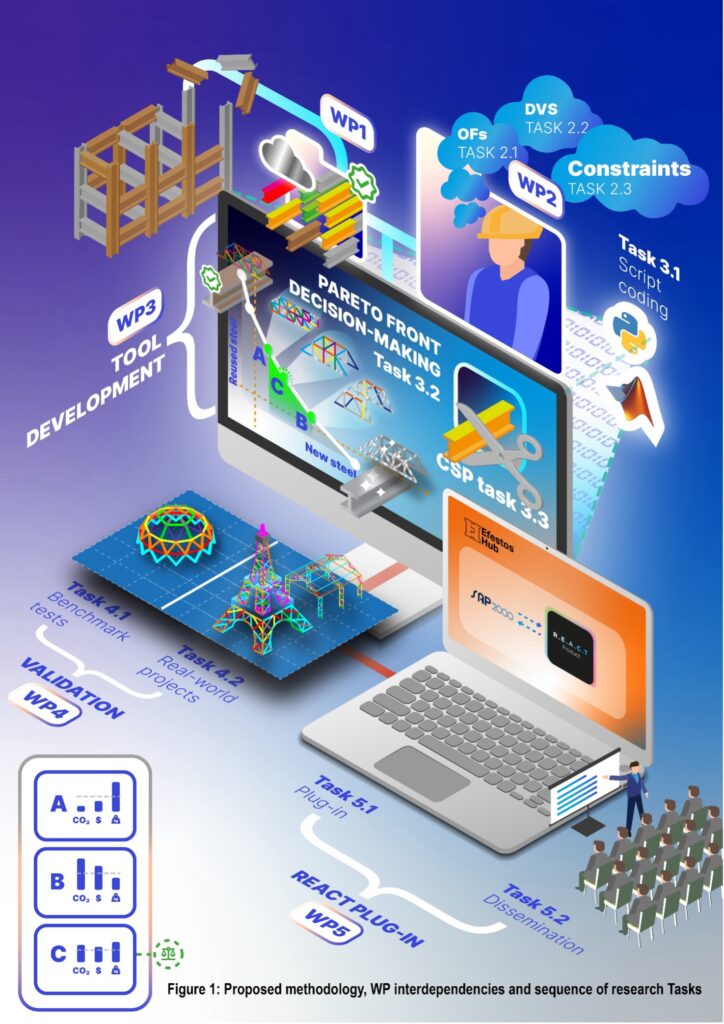
How to cite the project and the figure/plot above:
R.E.A.C.T.: Reusing steel for Emission reduction through AI-driven Cutting-stock Tool , HORIZON-MSCA-2024-PF-01, Grant agreement ID: 101202611, DOI: 10.3030/101202611, funded under Marie Skłodowska-Curie Actions (MSCA)
Relevant EU policies and strategies:
- European Commission. (2024). Horizon Europe strategic plan 2025–2027. Publications Office of the European Union.
- European Commission. (2022). Sustainable products initiative. In Circular Economy Action Plan. Publications Office of the European Union.
- European Commission. (2021). European Green Deal: Commission proposes transformation of EU economy and society to meet climate ambitions. EC 14/7/2021.