
Here you will find news relevant to the activities of the initiative including webinars, talks, consulting projects, publications, participation in conferences and meetings mostly relevant to resilience of critical infrastructure with emphasis on transport and energy assets and their intra/interdependencies, views on the UNs Sustainable Development Goals and use of digital and emerging technologies in infrastructure resilience- and sustainability-based management
14
Oct 26
Our New Paper Explores Governance and Resilience in Ageing Metro Systems
Our new open-access paper, “Governance transitions in underground infrastructure: Coordinating resilience enhancement of ageing metro systems”, has been published in Tunnelling and Underground Space Technology.
The study introduces a lifecycle-informed, tripartite evolutionary game framework to examine how governments, infrastructure operators and the public collectively shape metro-system resilience. It demonstrates that resilience is not exclusively a technical challenge: governance, institutional incentives and collective behaviour can be equally important.
The findings show that resilience may undergo abrupt transitions rather than improve gradually, highlighting why societies sometimes choose—or fail—to invest in more resilient infrastructure.
7
Oct 26
New Open-Access Paper Published in Communications Engineering, a Nature Portfolio Journal
A new paper titled “Operationalizing resilience for sustainable infrastructure governance across the life cycle” has been published in Communications Engineering, part of Nature Portfolio.
The study presents a decision-oriented framework integrating resilience and recovery assessment, Life Cycle Assessment, Life Cycle Costing and multi-criteria decision analysis. Applied to the Polyfytos Bridge in Greece, it compares six adaptation strategies across resilience, carbon, cost and service-life objectives.
The findings demonstrate how system-level transformation with limited structural intervention can outperform conventional approaches, supporting more resilient, sustainable and economically viable infrastructure decisions.
The research was developed by Marco Domaneschi, Nadiia Kopiika, Roberta Di Bari, Paola Cavallaro, Valentina Villa, Sotirios Argyroudis and Stergios-Aristoteles Mitoulis.
7
Oct 26
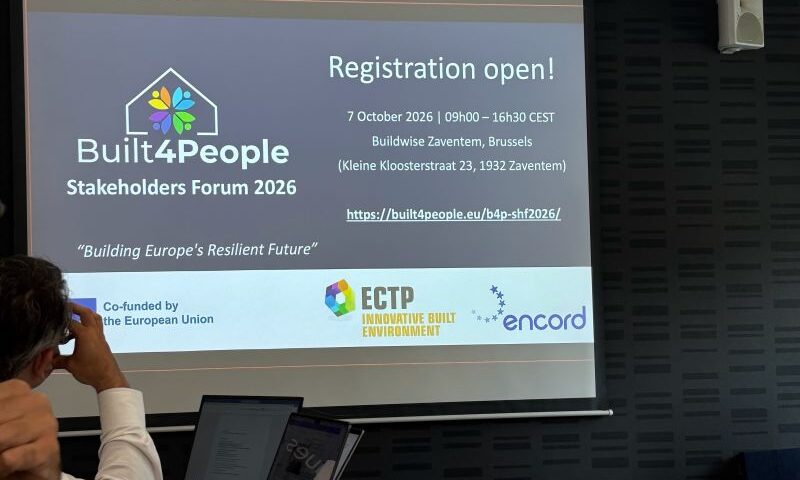
From isolated risks to systemic resilience at the 5th Built4People Stakeholders Forum in Brussels
Professor Stergios-Aristoteles Mitoulis presented at the 5th Built4People Partnership Stakeholders Forum in Brussels, which brought together the European Commission, CINEA, policymakers, industry and researchers under the theme Building Europe’s Resilient Future.
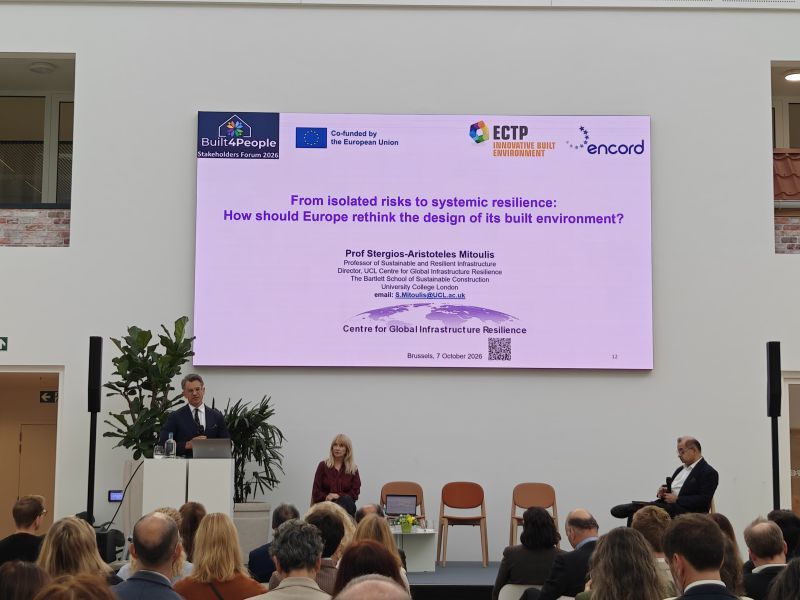
Representing The Bartlett School of Sustainable Construction at UCL and the UCL Centre for Global Infrastructure Resilience (GIROS), he highlighted the need to move beyond isolated risks towards systemic and sustained resilience. The contribution emphasised that resilience must be designed, maintained and adapted throughout the lifecycle of cities and infrastructure, considering interconnected systems, cascading risks and people-centred recovery.
21
Sep 26
Sustained Resilience for Future Cities at the Resilience World Nexus (RWN) Summit 2026
Professor Stergios-Aristoteles Mitoulis, Founding Director of the Centre for Global Infrastructure Resilience at UCL, will join a distinguished panel exploring how resilience can be embedded throughout urban planning, design, infrastructure, investment and adaptation.
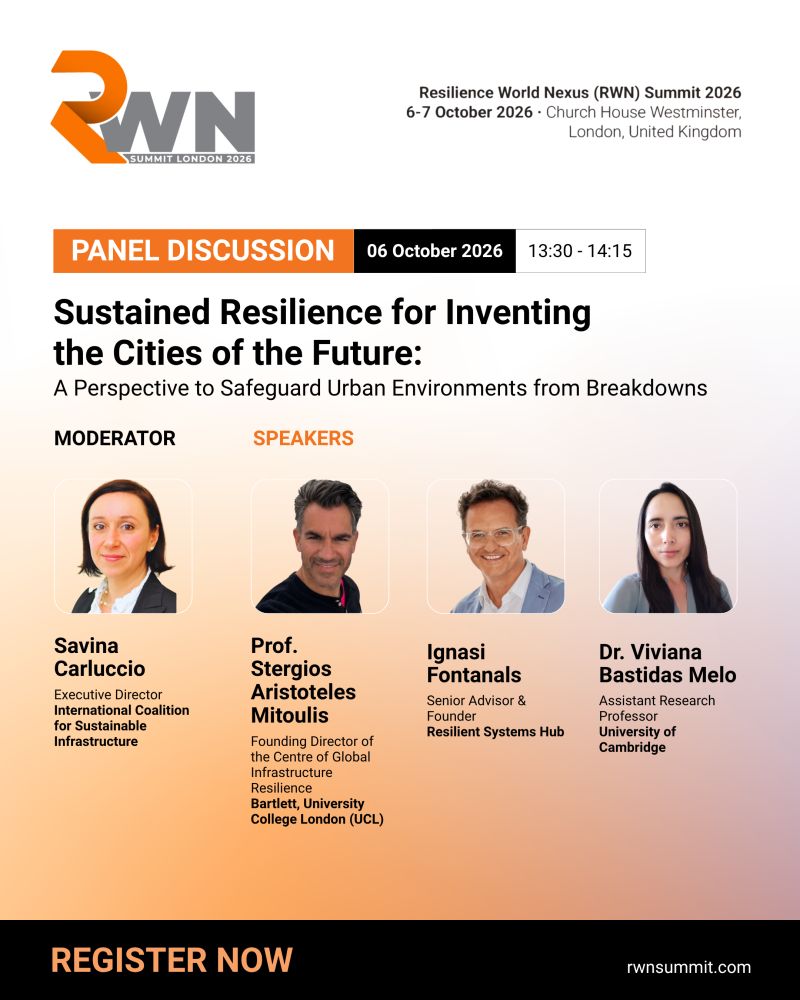
Moderated by Savina Carluccio, the session will also feature Ignasi Fontanals and Viviana Angely Bastidas Melo. Discussions will examine how climate modelling, risk assessment, advanced construction materials and economic frameworks can help cities withstand future disruptions.
📅 6 October 2026 | 13:30–14:15
📍 Hoare Memorial Hall, Church House Westminster, London
15
Sep 26
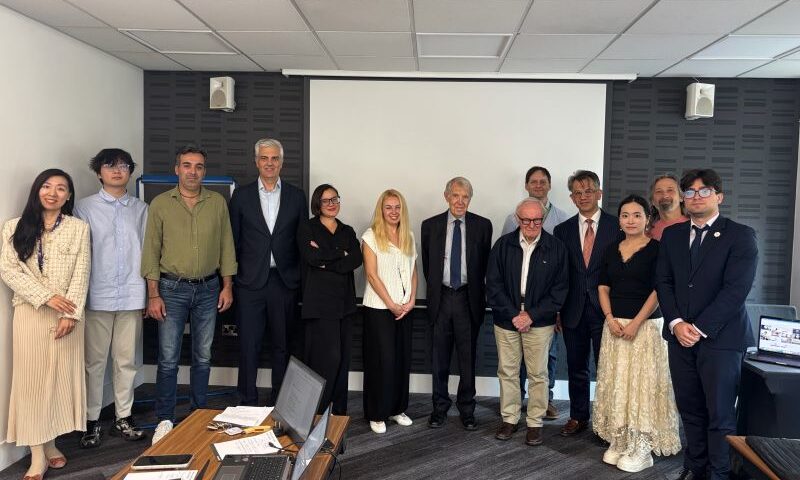
Inventing the Resilient Cities of the Future
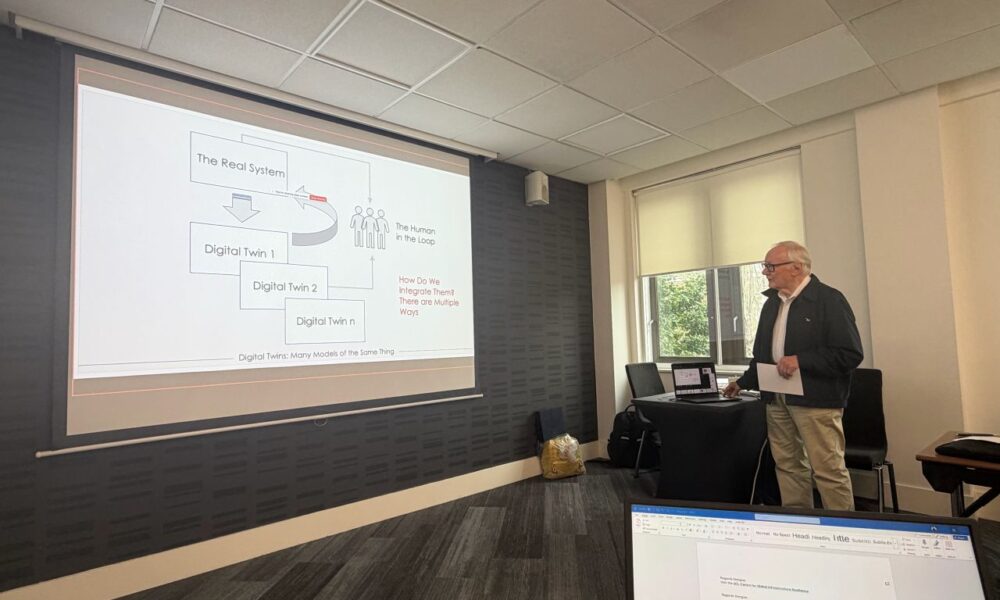
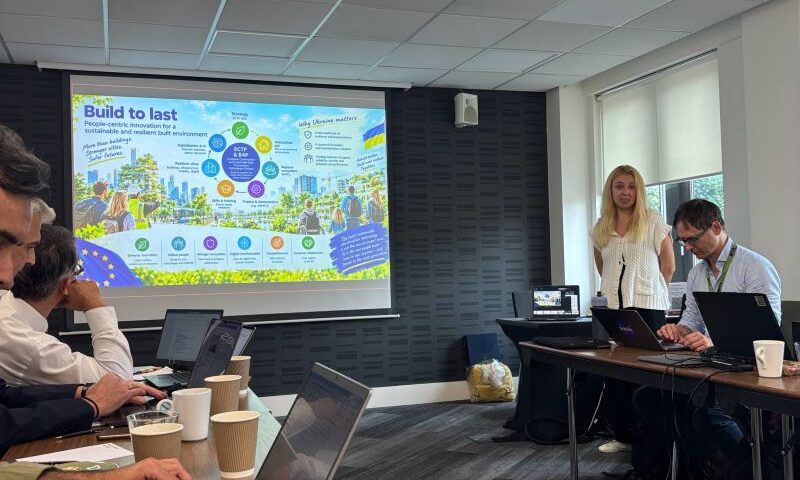
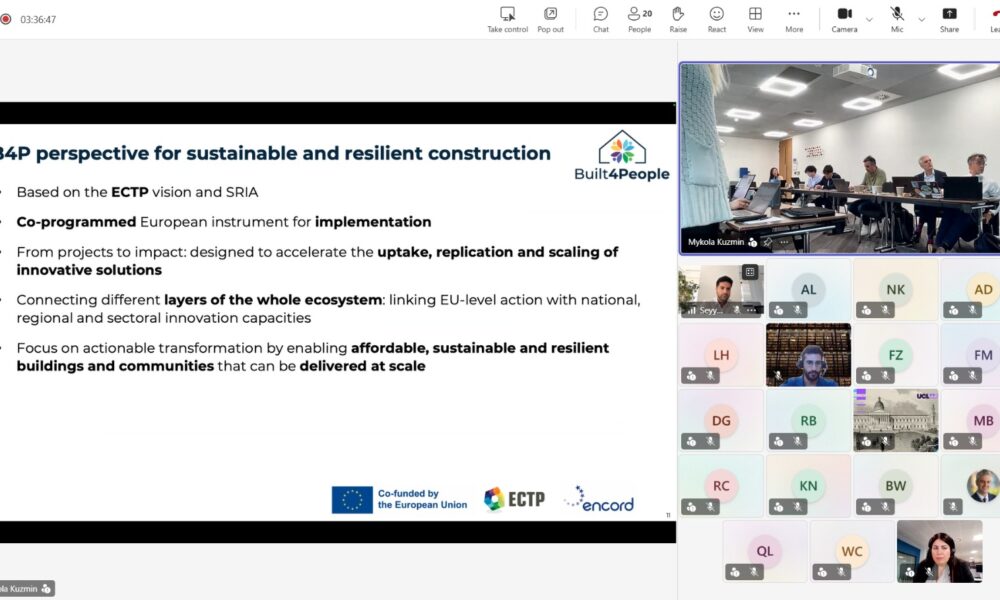
The Centre for Global Infrastructure Resilience (GIROS) at UCL brought together researchers, practitioners and collaborators for a stimulating discussion on the future of cities and infrastructure.
The event welcomed Professor Sir Alan Wilson, Professor Michael Batty and Dr Anastasiya Yurchyshyna, with discussions covering artificial intelligence, digital twins, systemic resilience and Build4People. A central message was that urban resilience cannot be understood asset by asset: buildings, transport, energy, communications, institutions and communities must be considered as interconnected systems.
The event reinforced the importance of systemic, sustained and people-centred approaches to building more resilient and sustainable cities.
1
Sep 26
Registration Now Open: First PORTAL Hybrid Workshop at UCL
Building Resilience in Port-City Systems: From Threat-Agnostic Thinking to Practical Action
The workshop will explore how threat-agnostic resilience thinking can be translated into practical approaches for strengthening complex port-city systems.
Event details
- Date: Monday, 14 September 2026
- Time: 14:00–17:00 BST
- Venue: Marshgate, UCL East
- Format: Hybrid — in person and online
Those wishing to attend are invited to register in advance.
25
Aug 26
New Paper Introduces Sustained Resilience
A new Perspective from the MetaInfrastructure team, titled “Sustained resilience as a unifying property of cities and the built environment”, has been published in npj Urban Sustainability, part of Nature Portfolio.
Led by Professor Stergios-Aristoteles Mitoulis and developed with Nadiia Kopiika, Roberta Di Bari and Sotirios Argyroudis, the paper introduces Sustained Resilience (Σ) as a unifying lifecycle property connecting resilience and sustainability. It captures how cities and infrastructure age, adapt, recover and regenerate over time, moving beyond event-based recovery towards long-term and adaptive resilience assessment.
The work was developed through the Centre for Global Infrastructure Resilience at UCL, MetaInfrastructure.org and BridgeUkraine, with support from the Horizon Europe projects ZEBAI and CLIMABUILD.
29
Jul 26
BridgeUkraine Featured in Royal Society Report
The Royal Society has published its report on the UK–Ukraine ResearchBridge, featuring BridgeUkraine.org as its first project showcase.
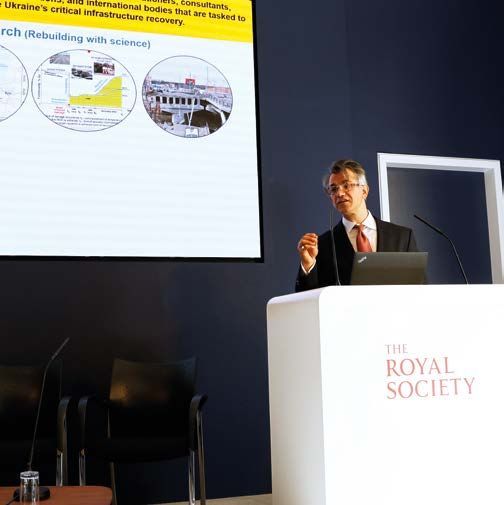
BridgeUkraine promotes a vision of reconstruction that goes beyond restoring what was lost. By connecting research, innovation, skills development, institutional partnerships and practical implementation, the initiative aims to support safer, smarter, more resilient and digitally enabled cities and infrastructure across Ukraine.
Developed through collaboration between UK and Ukrainian researchers, universities, industry and public institutions, BridgeUkraine demonstrates how international research partnerships can contribute directly to Ukraine’s recovery and long-term transformation.
24
Jul 26
STRONGER Horizon Europe success
STRONGER Horizon Europe success
We are delighted to announce that STRONGER – Strengthening Infrastructure Resilience through EU–Ukraine Research Collaboration has been selected for €1.5 million in funding under the Horizon Europe WIDERA Twinning Programme.
Starting in 2027, the three-year project will strengthen EU–Ukraine collaboration in infrastructure resilience, post-conflict reconstruction, AI-assisted damage assessment, digital technologies and research capacity building.
The project brings together Lviv Polytechnic National University as coordinator, UCL – The Bartlett School of Sustainable Construction, and TU Delft – Faculty of Civil Engineering and Geosciences.
We look forward to collaborating with this outstanding consortium to support resilient reconstruction in Ukraine and strengthen Europe’s preparedness for future infrastructure crises.
22
Jul 26
Stergios-Aristoteles Mitoulis appointed Professor at UCL
We are delighted to announce that Stergios-Aristoteles Mitoulis has been named Professor of Sustainable and Resilient Infrastructure at The Bartlett School of Sustainable Construction, UCL.