
MetaInfrastructure
metaCity smart, sustainable, inclusive
From Research to Software and Sustained Resilience platform and dashboards for people-centred, sustainable and resilient cities
Cities as interconnected systems
People at the centre of urban resilience
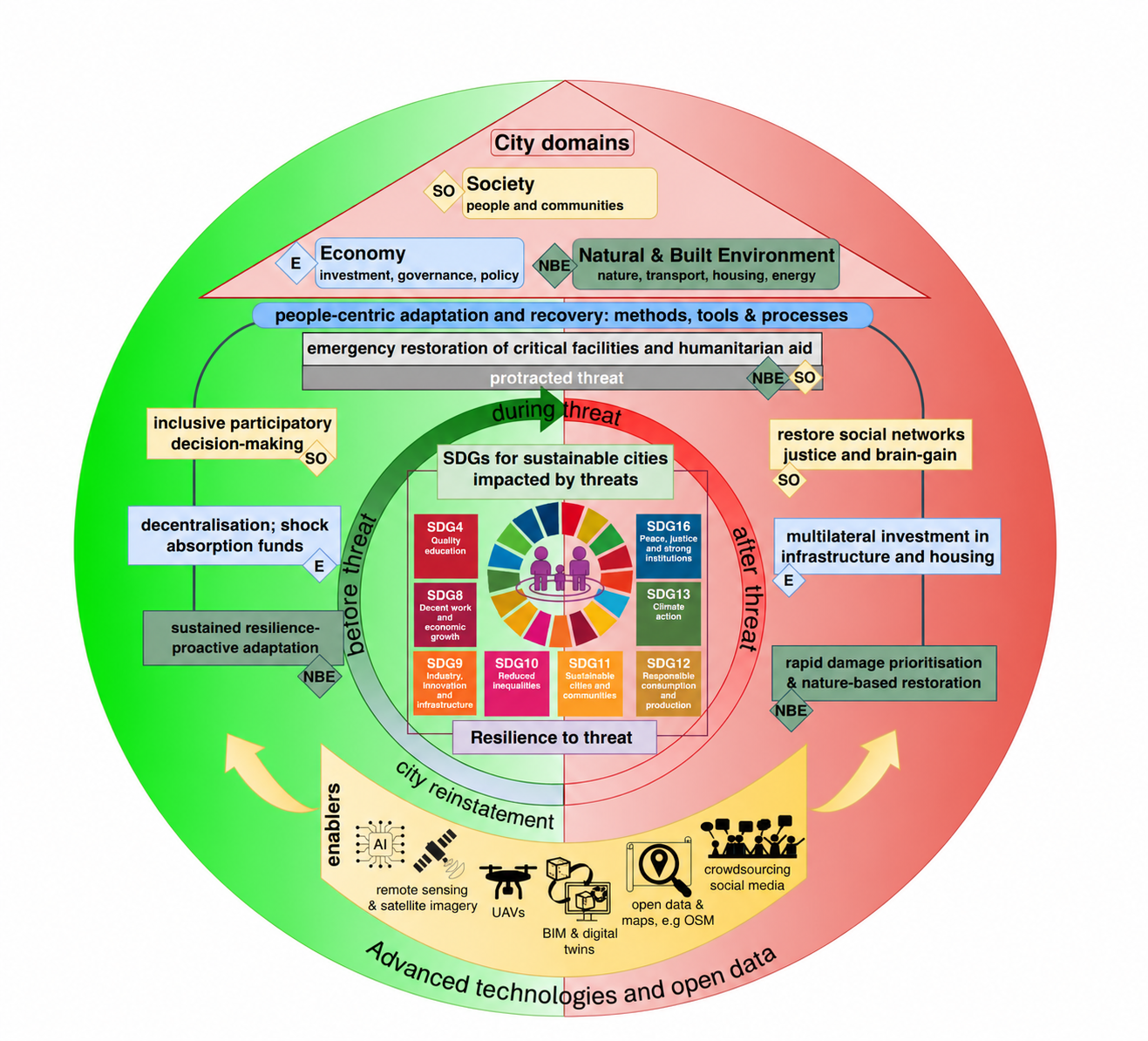
Cities are interconnected systems in which infrastructure, the natural environment, economies and communities continuously interact. Climate extremes, ageing infrastructure, cyber-physical disruptions and emerging threats can trigger cascading failures across essential services, while urbanisation and social inequalities increase systemic vulnerabilities.
Our metaCity research advances a people-centred, threat-agnostic approach to urban resilience and sustainability. We explore how cities can maintain essential functions, adapt to disruptions and evolve sustainably over time, integrating scientific evidence, digital innovation and inclusive governance.
 View larger figure
Our approach to metaCity
Connecting people, digital transformation and sustained resilience.
People-centred and threat-agnostic urban resilience
We investigate interdependencies and cascading risks across urban infrastructure, services and communities. Our approach combines anticipatory adaptation, emergency response and long-term recovery, focusing on essential urban functions, equitable access to services and participatory decision-making.
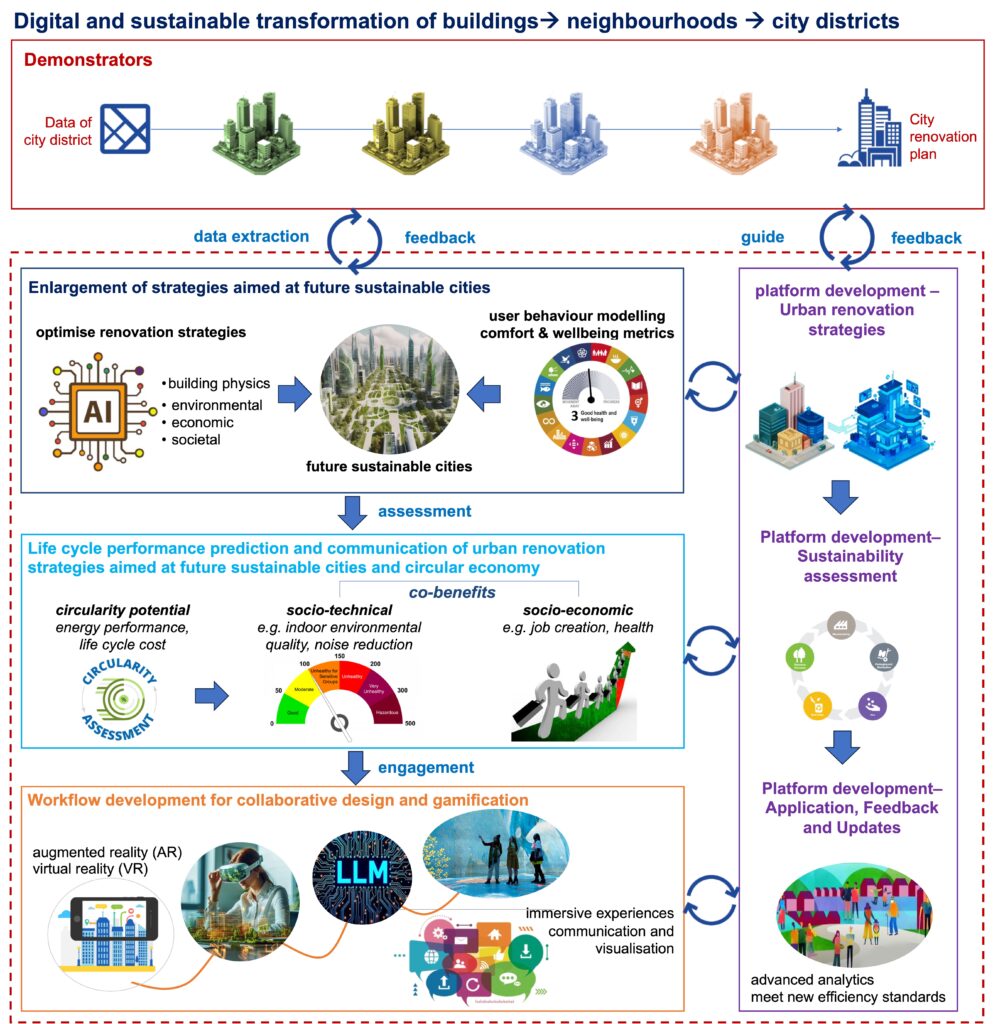
Digital and sustainable transformation across scales
We integrate remote sensing, building information modelling (BIM), digital twins, open data and AI-assisted analysis to inform urban planning and adaptation. Connecting buildings, neighbourhoods and city districts, these technologies support the evaluation of alternative development pathways, lifecycle performance, environmental impacts and socioeconomic benefits.
 View larger figure
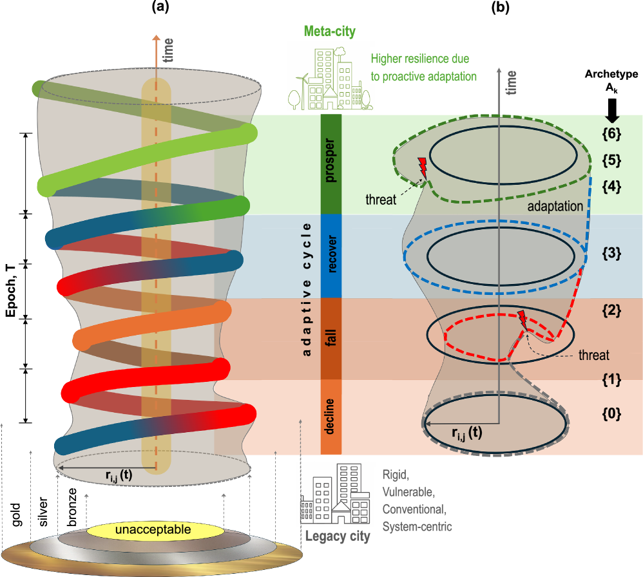
Sustained resilience across urban lifecycles
We advance sustained resilience as an integrated perspective on resilience and sustainability, capturing how cities maintain, recover and improve their performance across successive cycles of disruption, adaptation and renewal.
Moving beyond short-term recovery, this lifecycle-oriented approach connects infrastructure functionality, environmental performance, economic viability and social inclusion across urban systems and planning epochs.
 View larger figure
Urban design & decision support
MetaCity Generator
Software and visualization platform for Sustained Resilience dashboards
In brief. MetaCity Generator connects spatial analysis, design generation and performance evaluation in a single workflow, turning open urban data into evaluated design scenarios in minutes. We are now extending it into a sustained resilience dashboard that shows how a city responds to hazards, to inform sustainable urban development.
1. Why MetaCity Generator
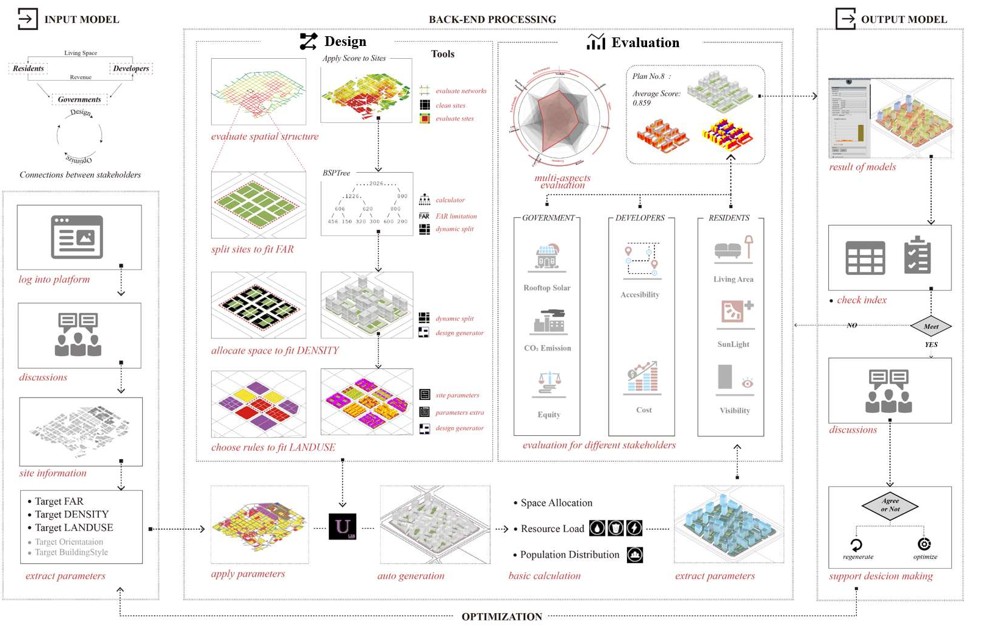
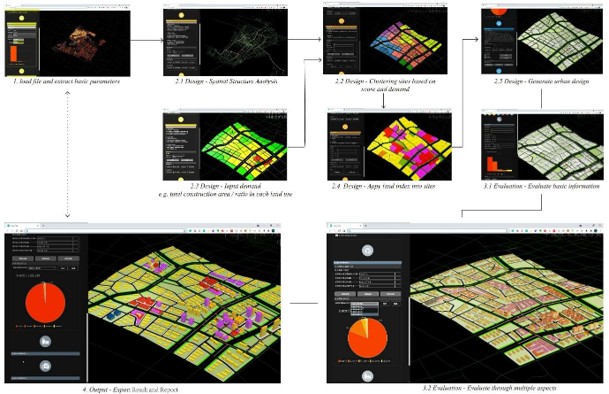
Urban decisions depend on many kinds of evidence: how people move through the city, how much can be built where, and how a proposal performs for residents, developers and government. These questions are usually answered with separate tools and specialists, which makes the process slow, costly and hard to reproduce. MetaCityGenerator[1] brings them together in one parametric environment. When an input changes, every downstream analysis and design updates automatically, so teams can explore and compare options quickly and transparently.
How it works
Stakeholders define requirements such as target floor area ratio (FAR), density and land-use mix. The platform then analyses spatial structure, generates designs within these constraints and evaluates their performance, presenting the results for decision support.
Spatial structure analysis
Space syntax and network centrality measures identify corridors and locations with strong potential for movement and activity.
Generative design
A constraint-optimisation engine allocates building volumes and floor area across parcels within planning limits, linking development to accessibility.
Multi-stakeholder evaluation
Scenarios are assessed for government, developers and residents, considering accessibility, equity, cost, living space, sunlight and visibility.
 View larger figure
Case-study demonstration
Guangzhou, China
On an urban renewal site in Baiyun District, the reported demonstration completed the workflow from data to evaluated design in approximately five minutes, generating buildings across 156 parcels.
In the resulting scheme, 78% of residential units were within 400 m of high-accessibility corridors, and 94% of dwellings met the city’s winter sunlight requirement.
 View larger figure
Towards a sustained resilience dashboard
We are extending MetaCityGenerator from urban design to urban resilience. The planned dashboard will combine open infrastructure data with population and economic data to simulate how a city responds to hazards, identify disrupted services and affected communities, and explore best- and worst-case outcomes.
It will trace resilience through emergency response, recovery, reconstruction and adaptation. Linking these insights to the design tools will help decision makers prioritise interventions that maintain essential functions and guide recovery towards more sustainable urban development.
Applications and tailored support
The platform and its planned resilience extension are intended to support:
- Accessibility and spatial-structure diagnostics to identify critical areas and service gaps.
- Scenario-based masterplanning to generate and compare development options.
- Multi-stakeholder performance assessment for transparent discussion of competing priorities.
- Infrastructure resilience assessment and recovery planning across different time horizons.
- Decision-support dashboards and training tailored to each city’s data and needs.
Further reading
Lin, A., Yang, T., Wan, B., Law, S., & Penn, A. (2026). MetaCityGenerator: A Comprehensive Parametric Design Tool Bridging Space Syntax Analysis and Urban Design Generation. Proceedings of the 15th International Space Syntax Symposium Malaysia 2026.
Read the publicationResearch into practice
Impact



Our research aims to support more resilient, sustainable and equitable cities by informing evidence-based investment, adaptive urban planning and accountable governance. By combining systems thinking, digital innovation and community priorities, metaCity seeks to strengthen service continuity, reduce environmental impacts and support long-term societal wellbeing and prosperity.
Research underpinning metaCity
Nature Cities · 2026
A new paradigm for resilient and equitable post-war recovery of cities
Nature Cities, 3, 304–307 (2026).
Read papernpj Urban Sustainability · 2026
Sustained resilience as a unifying property of cities and the built environment
npj Urban Sustainability, 6, 114 (2026).
Read paper