Research can sound complex, but its purpose is simple
At MetaInfrastructure, we explore how the places and systems we all rely on — such as cities, bridges, transport, and energy networks — can be safer, fairer, and better prepared for the future.
We study how infrastructure is affected by climate change, natural hazards, and rapid urban growth, and we develop practical tools, ideas, and technologies to make these systems more resilient, sustainable, and people-centric. Our work combines engineering with digital technologies such as artificial intelligence, data modelling and smart sensors to help decision-makers tackle real challenges and improve everyday life for communities around the world.
Meet our Research:
The Crowd knows best: ensemble-based learning for complex civil engineering applications

by Ivan Izonin, Associate Professor & Research Fellow
Ensemble learning is an approach in which multiple expert (weak learner) models are combined to obtain a more accurate and reliable prediction than any single model can provide. It operates by aggregating diverse decisions that partially compensate for one another’s individual errors. A key requirement is sufficient diversity and at least partial independence among the errors of the constituent models.
The conceptual foundation of ensemble learning traces back to the “wisdom of the crowd” principle (Galton, 1907), which showed that the averaged judgment of a large group of independent “experts” can surpass the accuracy of individual participants. In the context of machine learning, this means that combining several models, each offering a different interpretation of the data structure, leads to a more robust and dependable prediction than relying on any one model. A more formal justification comes from Condorcet’s jury theorem (Condorcet, 1785; later adapted for ML), which states that if each expert’s probability of being correct is slightly above random, then collective voting substantially increases overall accuracy as the number of experts grows. In machine learning, this explains why ensembles of many weak learners can outperform a single strong learner—provided that their errors are sufficiently diverse and only partially correlated.
Additional theoretical grounding is offered by the bias–variance decomposition (Geman et al., 1992), which demonstrates that averaging predictions across multiple models significantly reduces variance, i.e., fluctuations caused by sampling noise. At the same time, the increase in bias is minimal or negligible. As a result, ensembles produce more reliable, generalizable estimates, explaining their effectiveness across a broad range of tasks – from classical regression to complex high-dimensional classification problems.
Making Cities and Infrastructure Safer from Wildfires

by Stavros Sakellariou, Research Fellow
Wildfires are becoming more frequent and intense due to climate change, and they no longer affect only forests. Increasingly, fires threaten cities, homes, and critical infrastructure such as roads, power networks, and water systems—especially in areas where urban development meets vegetation. My research focuses on understanding how wildfires interact with cities and infrastructure, and how we can better prepare for and reduce their impacts.
This problem matters because wildfire impacts go far beyond burned land. They can disrupt daily life, endanger public health through smoke, damage essential services, and lead to costly evacuations and long recovery times. As more people live close to fire-prone landscapes, communities face growing risks to safety, economic stability, and quality of life.
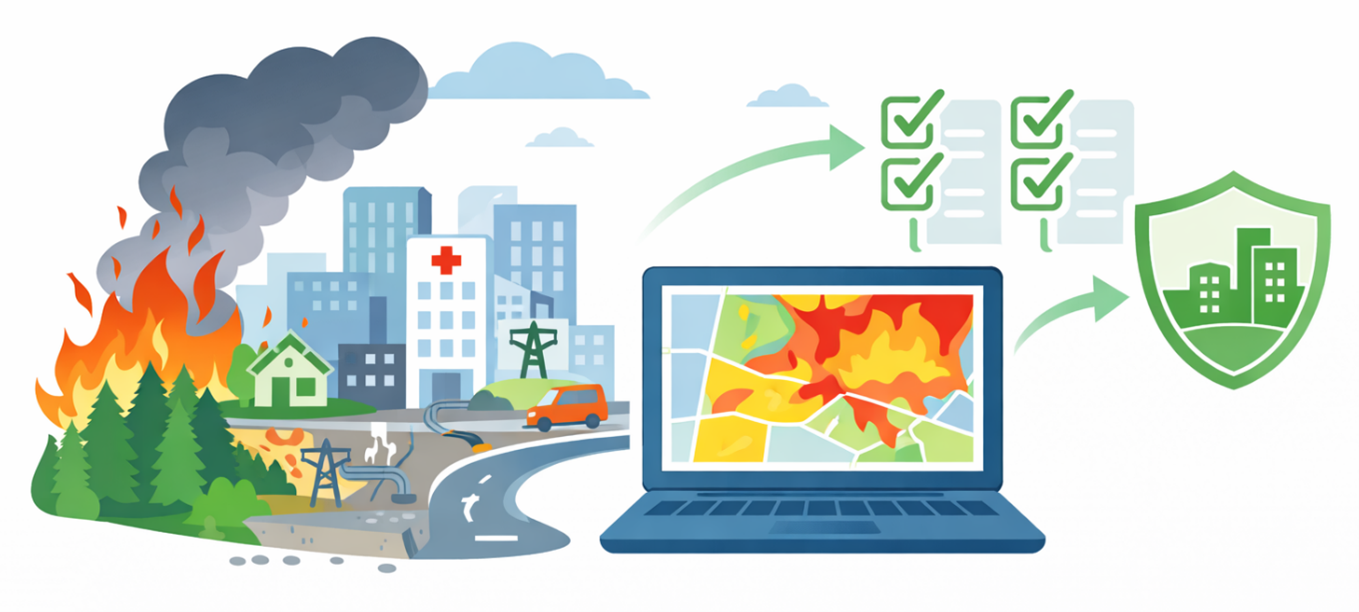
My research helps by combining spatial data, fire simulations, and infrastructure analysis to identify where risks are highest and which assets are most vulnerable. By translating complex wildfire behaviour into maps and indicators, the work supports planners, emergency services, and decision-makers in choosing smarter prevention measures, safer urban designs, and more effective response strategies—before disasters happen.
Understanding How Bridges Fail Under Extreme Events

By Henrry Vicente Rojas Asuero, PhD candidiate
Road bridges are critical links in transport networks, yet they are exposed to many types of extreme events. Strong earthquakes, floods, ageing, and increasing climate-related stresses can all reduce their ability to function safely. A major difficulty is that bridges that appear similar can respond very differently when exposed to these events, making it hard to anticipate damage and plan effective interventions.
My research aims to improve how we predict the performance of typical road bridges under extreme conditions. Rather than focusing on a single structure, I study groups of bridges with different geometries and characteristics to understand how their response varies and where uncertainty plays a key role.

This approach helps identify which features most influence damage and how reliable our predictions really are.
This work matters because infrastructure decisions are made with limited resources. By improving predictions of expected damage and uncertainty, my research supports better prioritisation of inspections, maintenance, and strengthening measures. In practical terms, it helps authorities reduce unexpected failures, manage costs more efficiently, and keep transport networks functioning when society depends on them most.
Cities as living bodies – a guide to smart preparation and fair recovery in conflict environments

By Nadiia Kopiika, Research Fellow
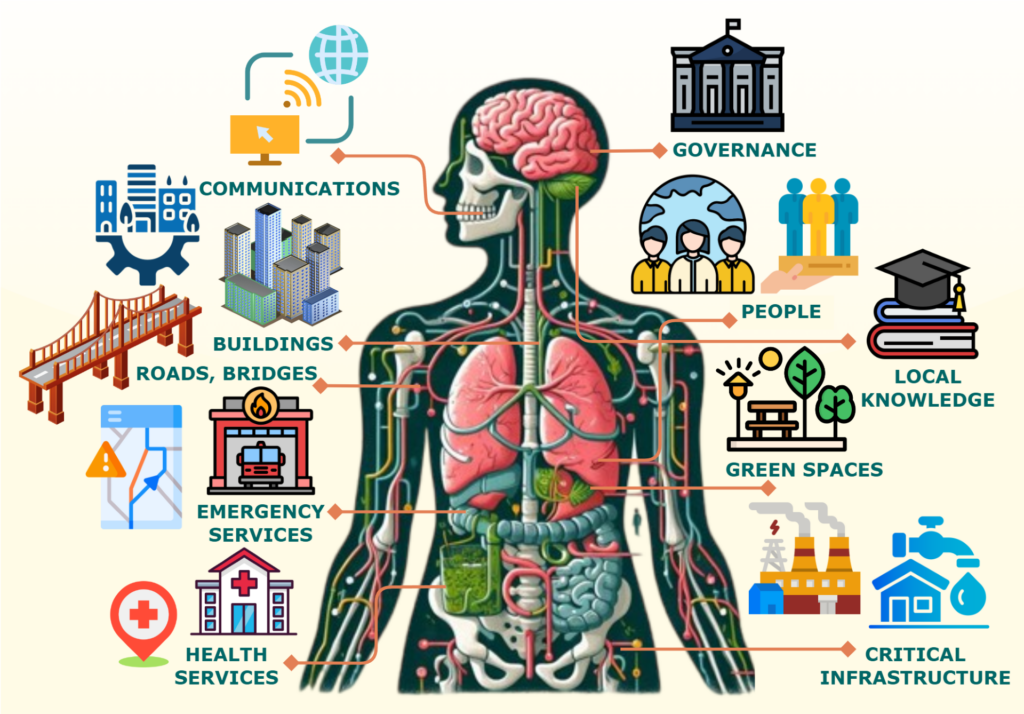
Imagine a city as a living body: roads are veins, power lines are nerves, water pipes are arteries, buildings are organs. War and conflict can injure that body – shattering services like water, power, roads, and hospitals – and leaving communities without basic needs. Recovery is often slow, fragmented, and disconnected from what people actually need, especially when access is limited and information is scattered. My work focuses on making restoration faster and more useful by diagnosing damage even with partial information and designing recovery that follows real priorities on the ground.
When a city’s “body” can’t function, people’s lives, health, and livelihoods are at risk. Prolonged outages raise costs, deepen inequality, and stall economic and social recovery. Faster, fairer rebuilding reduces suffering, restores essential services, and helps communities become safer and more resilient – so hospitals can treat patients, businesses can reopen, and children can return to school.
Like a doctor using diagnostics and patient history, I combine many kinds of clues – satellite images, maps, local reports, and open data – into clear, usable plans that show which “organs” and “veins” to treat first. I prepare “what if” plans before harm occurs and deliver rapid, people-centred steps after damage. By linking technical tools with local knowledge and social priorities, the approach supports transparent, equitable recovery that reduces long-term harm and builds stronger, more adaptable communities for the future.
Smart Passive Ventelation

By Dr Khrystyna Myroniuk, Associate Professor
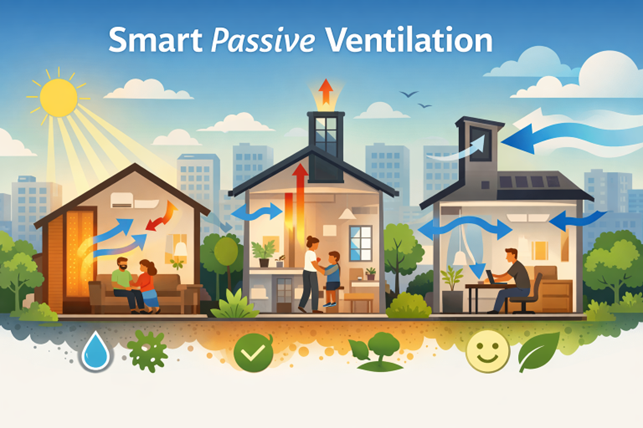
Nowadays many residential buildings are being upgraded with better insulation and new windows to reduce energy use and carbon emissions. However, these renovations often make homes much more airtight. While this improves energy efficiency, it can also reduce natural air exchange, leading to poor indoor air quality, moisture build-up, mould growth, and discomfort for occupants. These problems are especially common in buildings without mechanical ventilation, where residents depend on natural airflow.
My research addresses this challenge by developing a practical decision-support framework that helps communities and housing stakeholders choose passive ventilation solutions that work reliably in real conditions. The study focuses on wind catchers, solar chimneys, and Trombe walls – systems that use natural forces such as wind and solar heat to move fresh air indoors without extra energy demand. By combining digital airflow simulations with local climate data and building characteristics, the framework evaluates how well these systems perform under different weather and urban conditions, including dense neighbourhoods and seasonal variability.
The results show that combining several passive ventilation strategies can provide more stable ventilation, improve indoor comfort, and support healthier, more resilient retrofitted housing.