
Research can sound complex, but its purpose is simple
At MetaInfrastructure, we explore how the places and systems we all rely on — such as cities, bridges, transport, and energy networks — can be safer, fairer, and better prepared for the future.
We study how infrastructure is affected by climate change, natural hazards, and rapid urban growth, and we develop practical tools, ideas, and technologies to make these systems more resilient, sustainable, and people-centric. Our work combines engineering with digital technologies such as artificial intelligence, data modelling and smart sensors to help decision-makers tackle real challenges and improve everyday life for communities around the world.
Meet our researchers and explore their work through simple explanations and illustrative visuals.

The crowd knows best: ensemble-based learning for complex civil engineering applications

Making cities and infrastructure safer from wildfires

Cities as living bodies – a guide to smart preparation and fair recovery in conflict environments

Understanding how bridges fail under extreme events

Smart passive ventilation

Understanding how nature-based solutions can improve transport infrastructure resilience
Explore selected journal papers through short summaries, illustrative visuals and podcast episodes.
Threat-agnostic resilience: Framing and applications
A new paradigm for resilient and equitable post-war recovery of cities
Climate-resilient railway networks: a resource-aware framework
Coupled Urban Risks: A complex systems perspective with a people-centric focus

Enhancing sustainability and resilience against natural Hazard of the built environment—state of the art and development of a novel framework
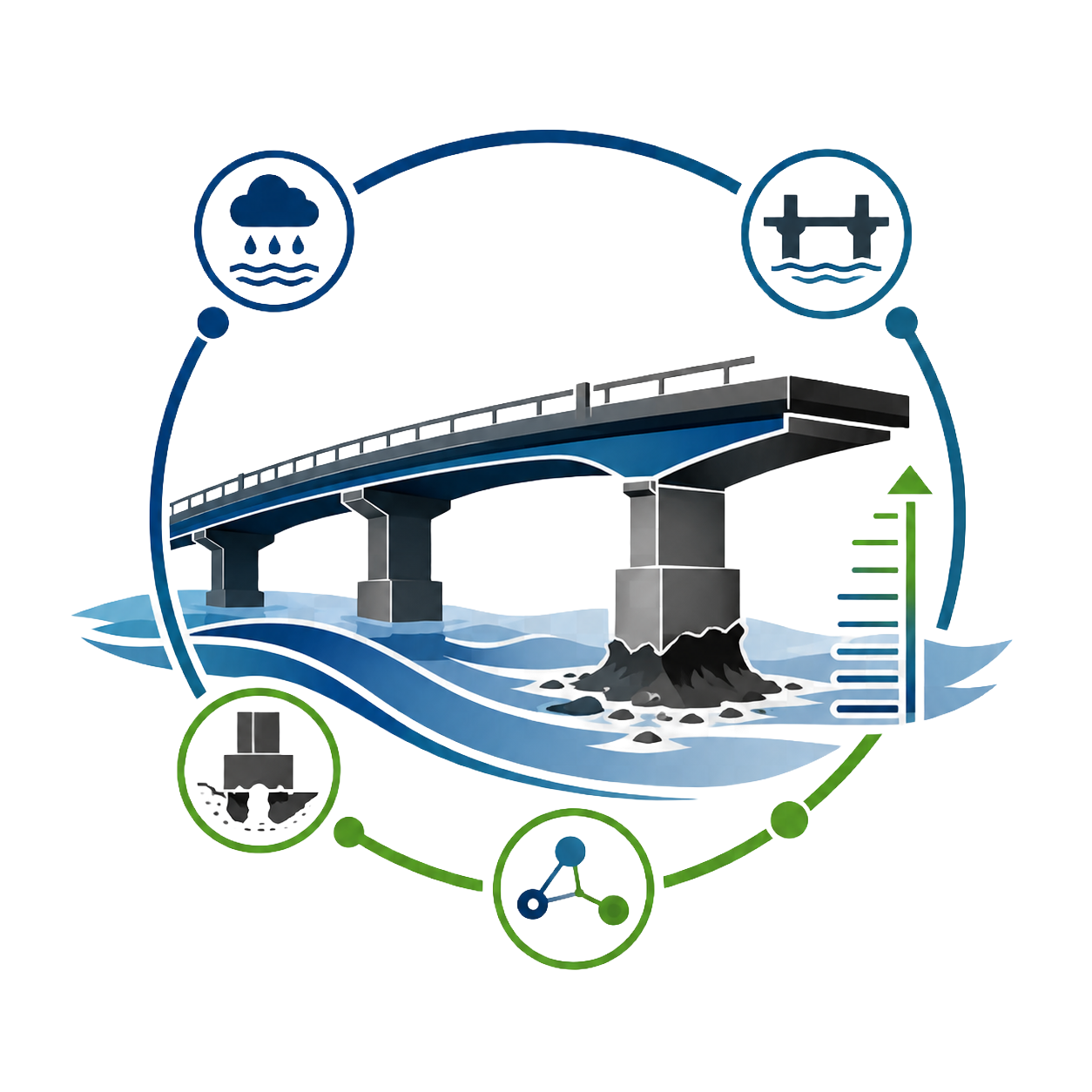
Flood fragility assessment of bridges—Unified framework
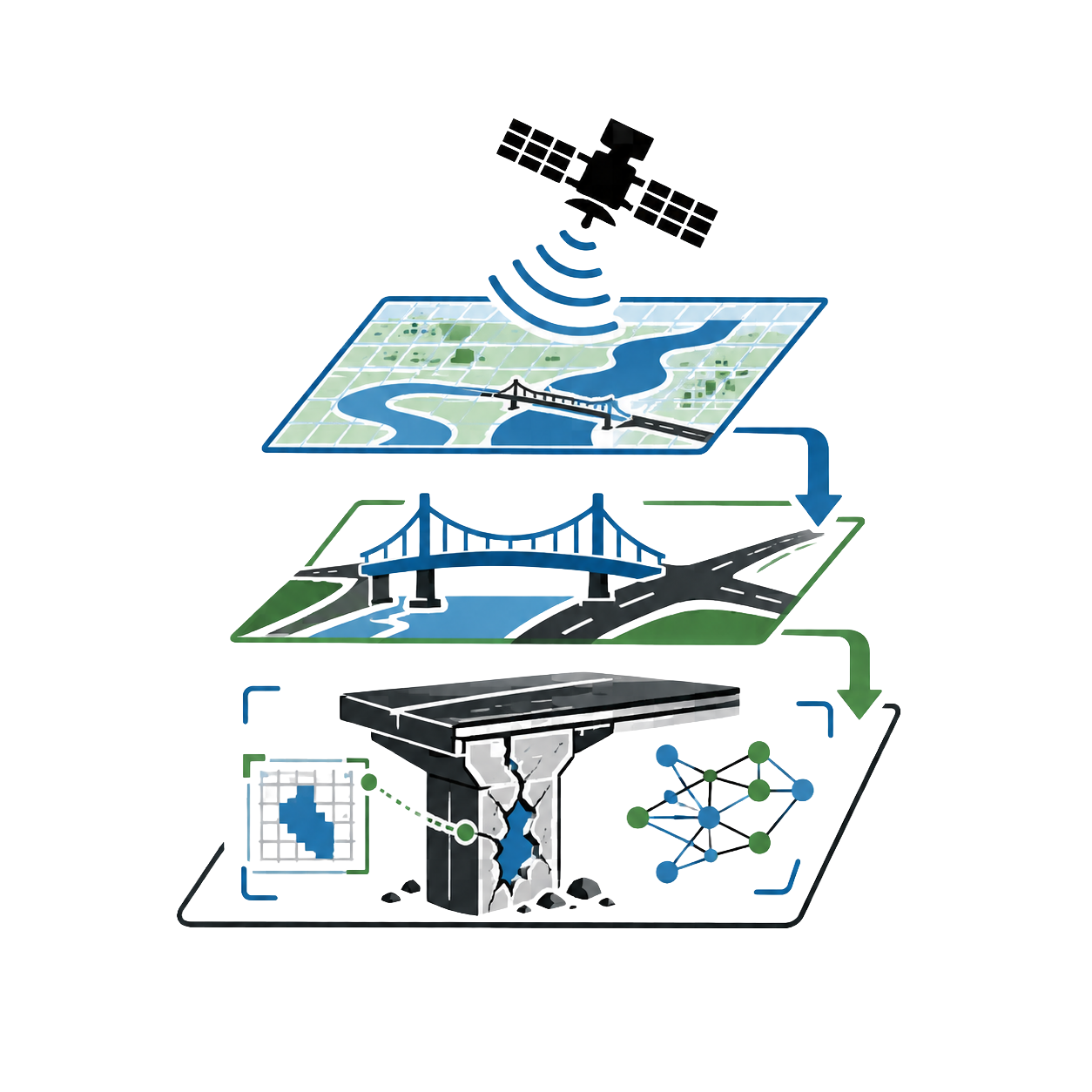
Rapid post-disaster infrastructure damage characterisation using remote sensing and deep learning technologies: A tiered approach
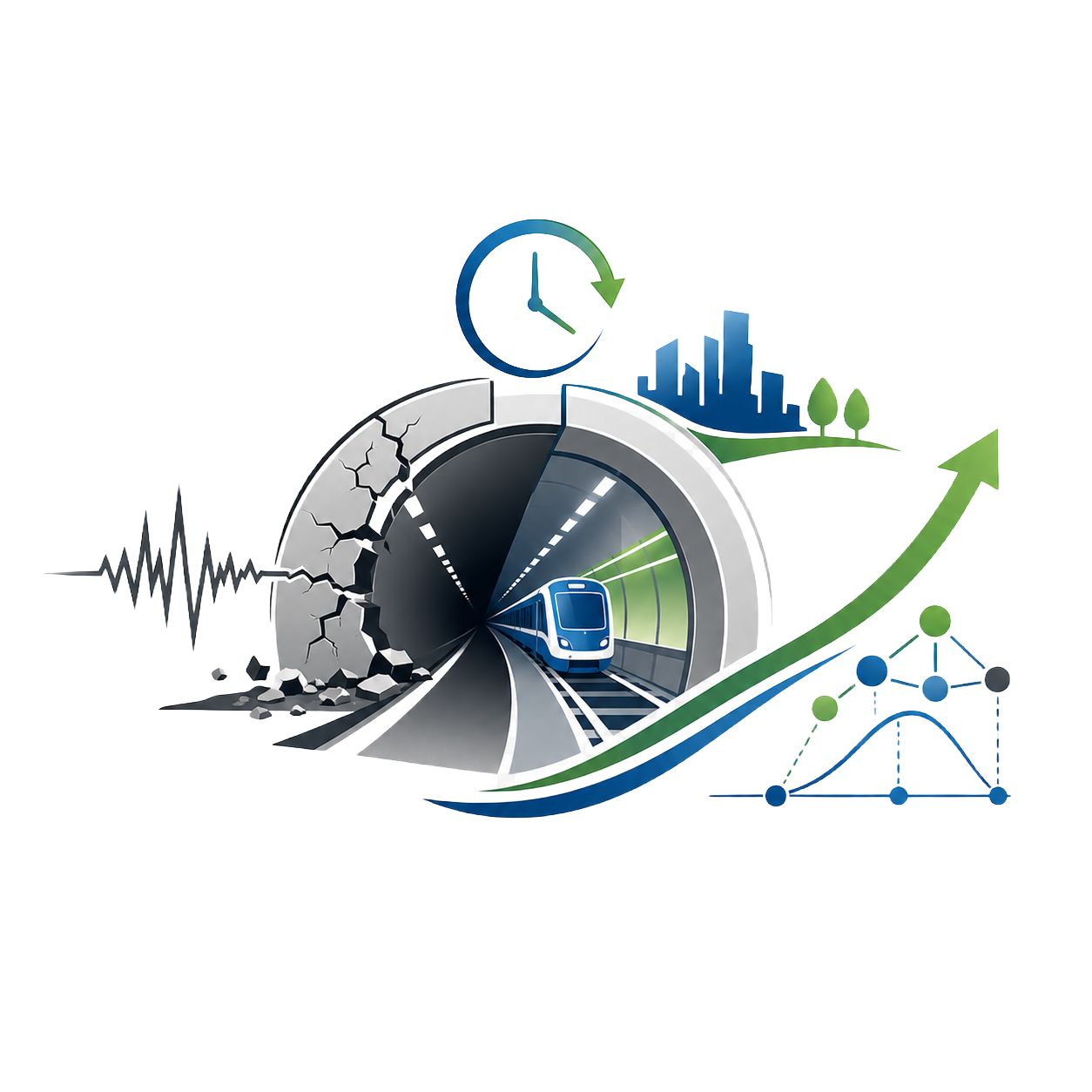
Resilience models for tunnel recovery after earthquakes
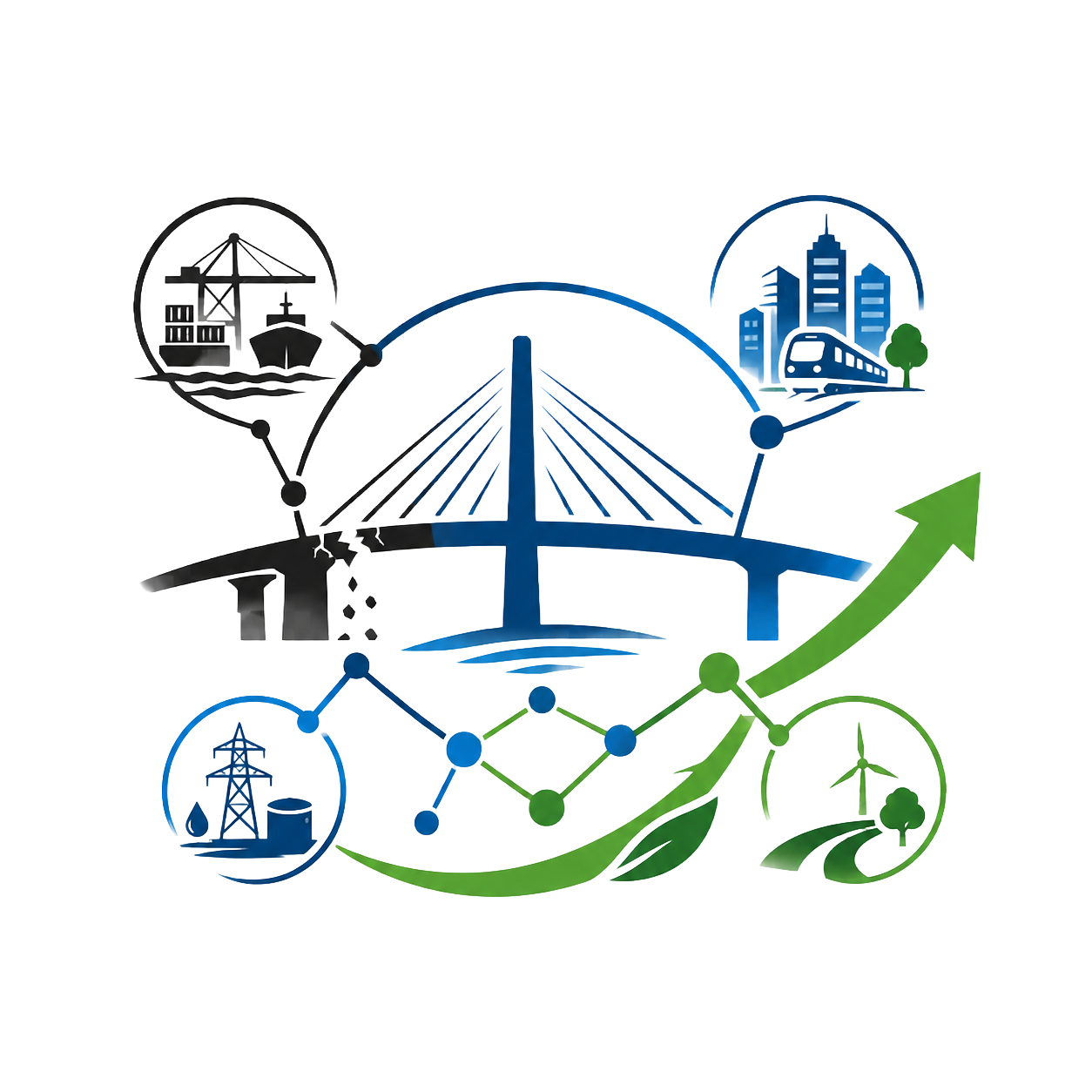
Rethinking infrastructure design from component failure to systemic resilience
Roadmap: integrating artificial intelligence in structural health monitoring systems
Ivan Izonin
Associate Professor & Research Fellow
The crowd knows best: ensemble-based learning for complex civil engineering applications
Ensemble learning is an approach in which multiple expert, or weak learner, models are combined to obtain a more accurate and reliable prediction than any single model can provide. It operates by aggregating diverse decisions that partially compensate for one another’s individual errors. A key requirement is sufficient diversity and at least partial independence among the errors of the constituent models.
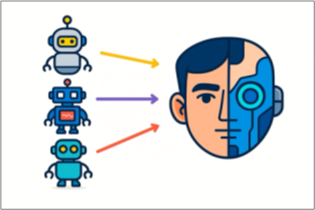
The conceptual foundation of ensemble learning traces back to the “wisdom of the crowd” principle (Galton, 1907), which showed that the averaged judgment of a large group of independent “experts” can surpass the accuracy of individual participants. In the context of machine learning, this means that combining several models, each offering a different interpretation of the data structure, leads to a more robust and dependable prediction than relying on any one model. A more formal justification comes from Condorcet’s jury theorem (Condorcet, 1785; later adapted for ML), which states that if each expert’s probability of being correct is slightly above random, then collective voting substantially increases overall accuracy as the number of experts grows. In machine learning, this explains why ensembles of many weak learners can outperform a single strong learner—provided that their errors are sufficiently diverse and only partially correlated.
Additional theoretical grounding is offered by the bias–variance decomposition (Geman et al., 1992), which demonstrates that averaging predictions across multiple models significantly reduces variance, i.e., fluctuations caused by sampling noise. At the same time, the increase in bias is minimal or negligible. As a result, ensembles produce more reliable, generalizable estimates, explaining their effectiveness across a broad range of tasks – from classical regression to complex high-dimensional classification problems.
Stavros Sakellariou
Research Fellow
Making cities and infrastructure safer from wildfires
Wildfires are becoming more frequent and intense due to climate change, and they no longer affect only forests. Increasingly, fires threaten cities, homes, and critical infrastructure such as roads, power networks, and water systems—especially in areas where urban development meets vegetation. My research focuses on understanding how wildfires interact with cities and infrastructure, and how we can better prepare for and reduce their impacts.
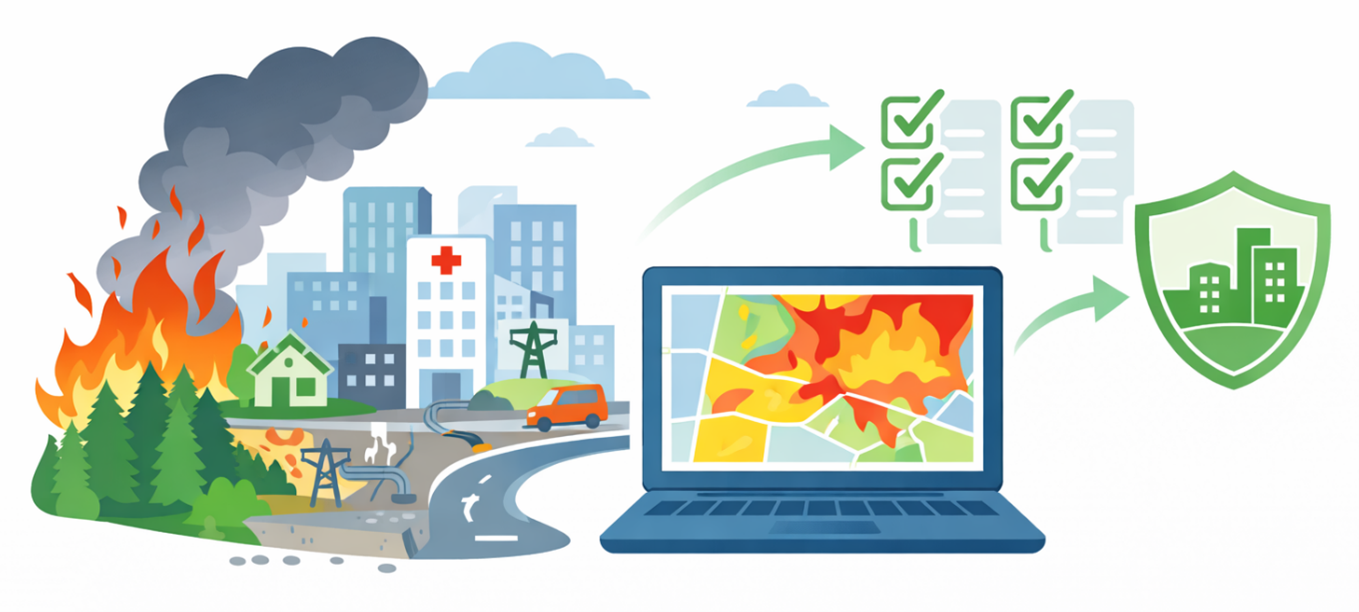
This problem matters because wildfire impacts go far beyond burned land. They can disrupt daily life, endanger public health through smoke, damage essential services, and lead to costly evacuations and long recovery times. As more people live close to fire-prone landscapes, communities face growing risks to safety, economic stability, and quality of life.
My research helps by combining spatial data, fire simulations, and infrastructure analysis to identify where risks are highest and which assets are most vulnerable. By translating complex wildfire behaviour into maps and indicators, the work supports planners, emergency services, and decision-makers in choosing smarter prevention measures, safer urban designs, and more effective response strategies—before disasters happen.
Nadiia Kopiika
Research Fellow
Cities as living bodies – a guide to smart preparation and fair recovery in conflict environments
Imagine a city as a living body: roads are veins, power lines are nerves, water pipes are arteries, buildings are organs. War and conflict can injure that body – shattering services like water, power, roads, and hospitals – and leaving communities without basic needs. Recovery is often slow, fragmented, and disconnected from what people actually need, especially when access is limited and information is scattered. My work focuses on making restoration faster and more useful by diagnosing damage even with partial information and designing recovery that follows real priorities on the ground.
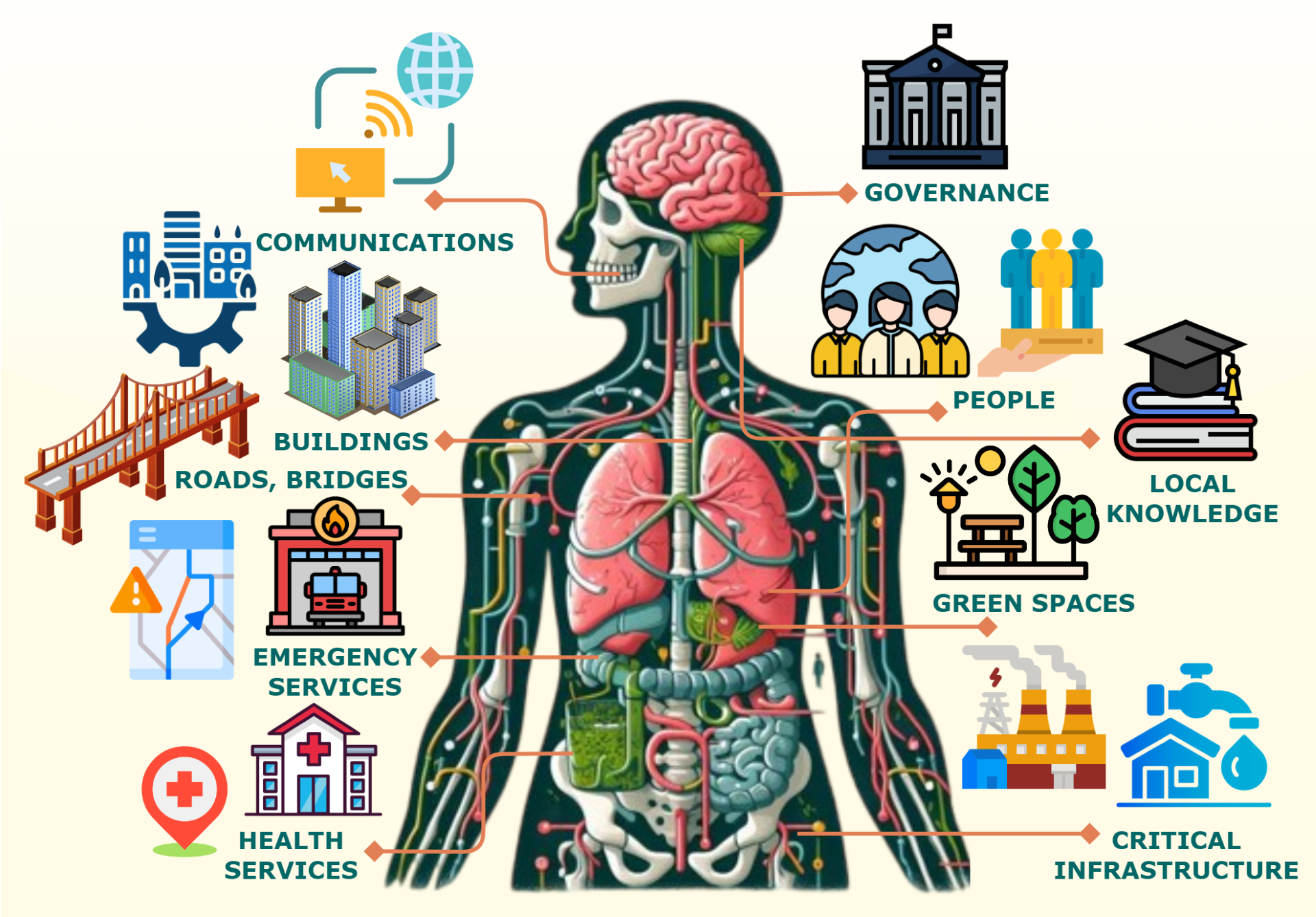
When a city’s “body” can’t function, people’s lives, health, and livelihoods are at risk. Prolonged outages raise costs, deepen inequality, and stall economic and social recovery. Faster, fairer rebuilding reduces suffering, restores essential services, and helps communities become safer and more resilient – so hospitals can treat patients, businesses can reopen, and children can return to school.
Like a doctor using diagnostics and patient history, I combine many kinds of clues – satellite images, maps, local reports, and open data – into clear, usable plans that show which “organs” and “veins” to treat first. I prepare “what if” plans before harm occurs and deliver rapid, people-centred steps after damage. By linking technical tools with local knowledge and social priorities, the approach supports transparent, equitable recovery that reduces long-term harm and builds stronger, more adaptable communities for the future.
Henrry Vicente Rojas Asuero
Research Fellow
Understanding how bridges fail under extreme events
Road bridges are critical links in transport networks, yet they are exposed to many types of extreme events. Strong earthquakes, floods, ageing, and increasing climate-related stresses can all reduce their ability to function safely. A major difficulty is that bridges that appear similar can respond very differently when exposed to these events, making it hard to anticipate damage and plan effective interventions. My research aims to improve how we predict the performance of typical road bridges under extreme conditions. Rather than focusing on a single structure, I study groups of bridges with different geometries and characteristics to understand how their response varies and where uncertainty plays a key role.

This approach helps identify which features most influence damage and how reliable our predictions really are. This work matters because infrastructure decisions are made with limited resources. By improving predictions of expected damage and uncertainty, my research supports better prioritisation of inspections, maintenance, and strengthening measures. In practical terms, it helps authorities reduce unexpected failures, manage costs more efficiently, and keep transport networks functioning when society depends on them most.
Khrystyna Myroniuk
Associate Professor
Smart passive ventilation
Nowadays many residential buildings are being upgraded with better insulation and new windows to reduce energy use and carbon emissions. However, these renovations often make homes much more airtight. While this improves energy efficiency, it can also reduce natural air exchange, leading to poor indoor air quality, moisture build-up, mould growth, and discomfort for occupants. These problems are especially common in buildings without mechanical ventilation, where residents depend on natural airflow.
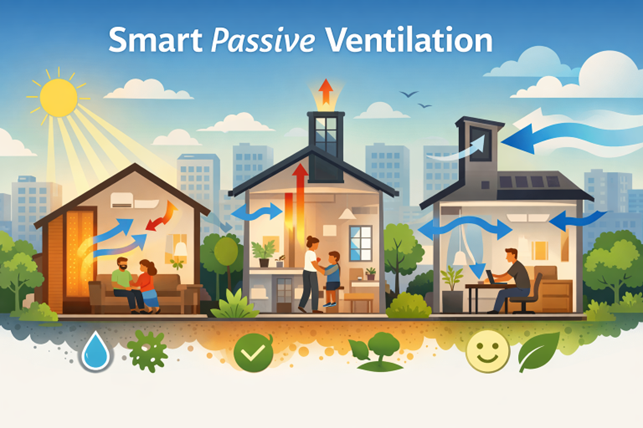
My research addresses this challenge by developing a practical decision-support framework that helps communities and housing stakeholders choose passive ventilation solutions that work reliably in real conditions. The study focuses on wind catchers, solar chimneys, and Trombe walls – systems that use natural forces such as wind and solar heat to move fresh air indoors without extra energy demand. By combining digital airflow simulations with local climate data and building characteristics, the framework evaluates how well these systems perform under different weather and urban conditions, including dense neighbourhoods and seasonal variability.
The results show that combining several passive ventilation strategies can provide more stable ventilation, improve indoor comfort, and support healthier, more resilient retrofitted housing.
Seyyed Mohammad Hosseini
PhD candidate
Understanding how nature-based solutions can improve transport infrastructure resilience
Transport infrastructure is increasingly exposed to climate-related hazards such as flooding, extreme rainfall, heatwaves, and long-term environmental deterioration. Road embankments, bridges, tunnels, and other critical assets are essential for keeping people, goods, and services moving, yet their performance can be significantly affected when extreme events occur. My research focuses on improving how we assess and enhance the resilience of transport infrastructure under changing climate conditions. Rather than looking only at traditional engineering solutions, I investigate how Nature-Based Solutions, such as vegetation-based slope protection, can contribute to safer, more sustainable, and climate-adaptive infrastructure.
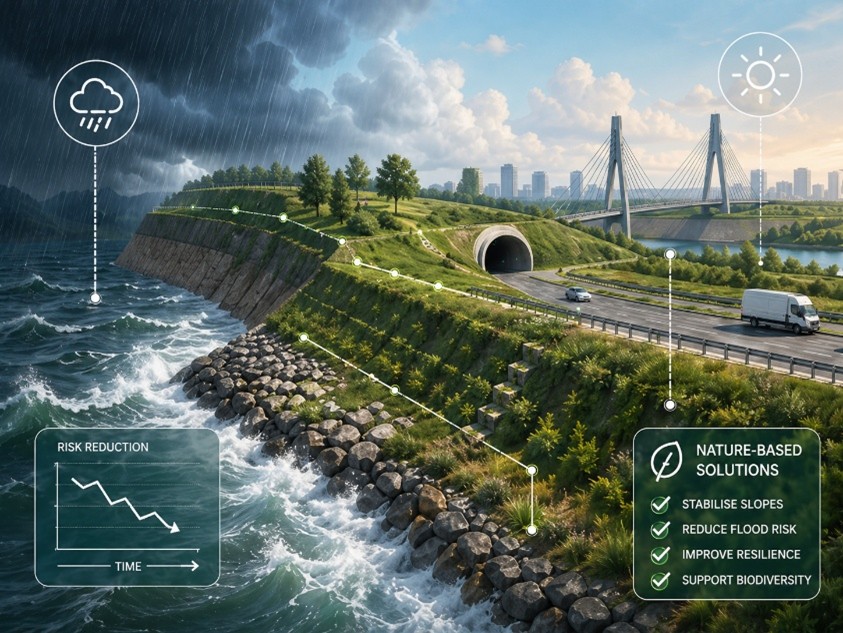
A key part of my work is to understand how different restoration and adaptation strategies influence infrastructure performance before, during, and after extreme events. Using numerical modelling, fragility analysis, recovery assessment, and lifecycle thinking, my research explores how infrastructure damage can be predicted, how recovery can be improved, and how the wider benefits of sustainable interventions can in decision-making.
This work matters because infrastructure managers and policymakers often need to make decisions with limited budgets and uncertain climate projections. By comparing conventional, nature-based, and hybrid solutions, my research aims to support better prioritisation of maintenance, adaptation, and investment strategies. In practical terms, it helps identify solutions that can reduce failure risk, improve recovery, lower long-term costs, and support more resilient and sustainable transport networks.
Threat-agnostic resilience: Framing and applications
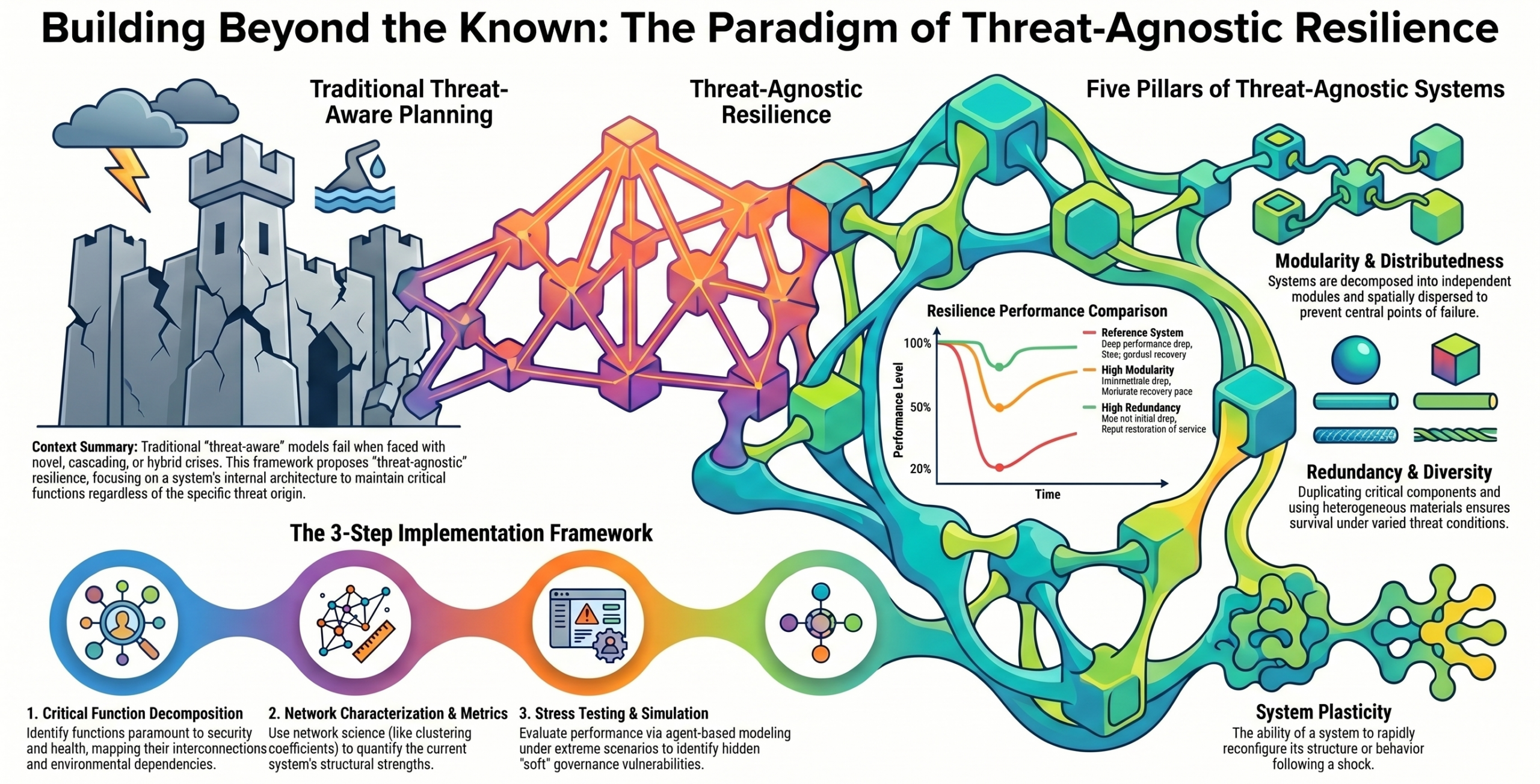
Simple summary
This paper explores a threat-agnostic resilience framework for protecting critical infrastructure from uncertain, cascading and interconnected disruptions. It explains why infrastructure systems should not be designed only around specific hazards, but around core resilience properties such as modularity, distributedness, redundancy, diversity and plasticity. The discussion highlights how network science can support measurable resilience assessment for systems such as power grids and transport networks, while balancing robustness, adaptability, operational efficiency and sustainability.
Key messages
- Resilience must go beyond hazard-specific planning.
- Infrastructure systems need adaptive and redundant design.
- The framework supports long-term resilient decision-making.
Podcast episode
A new paradigm for resilient and equitable post-war recovery of cities
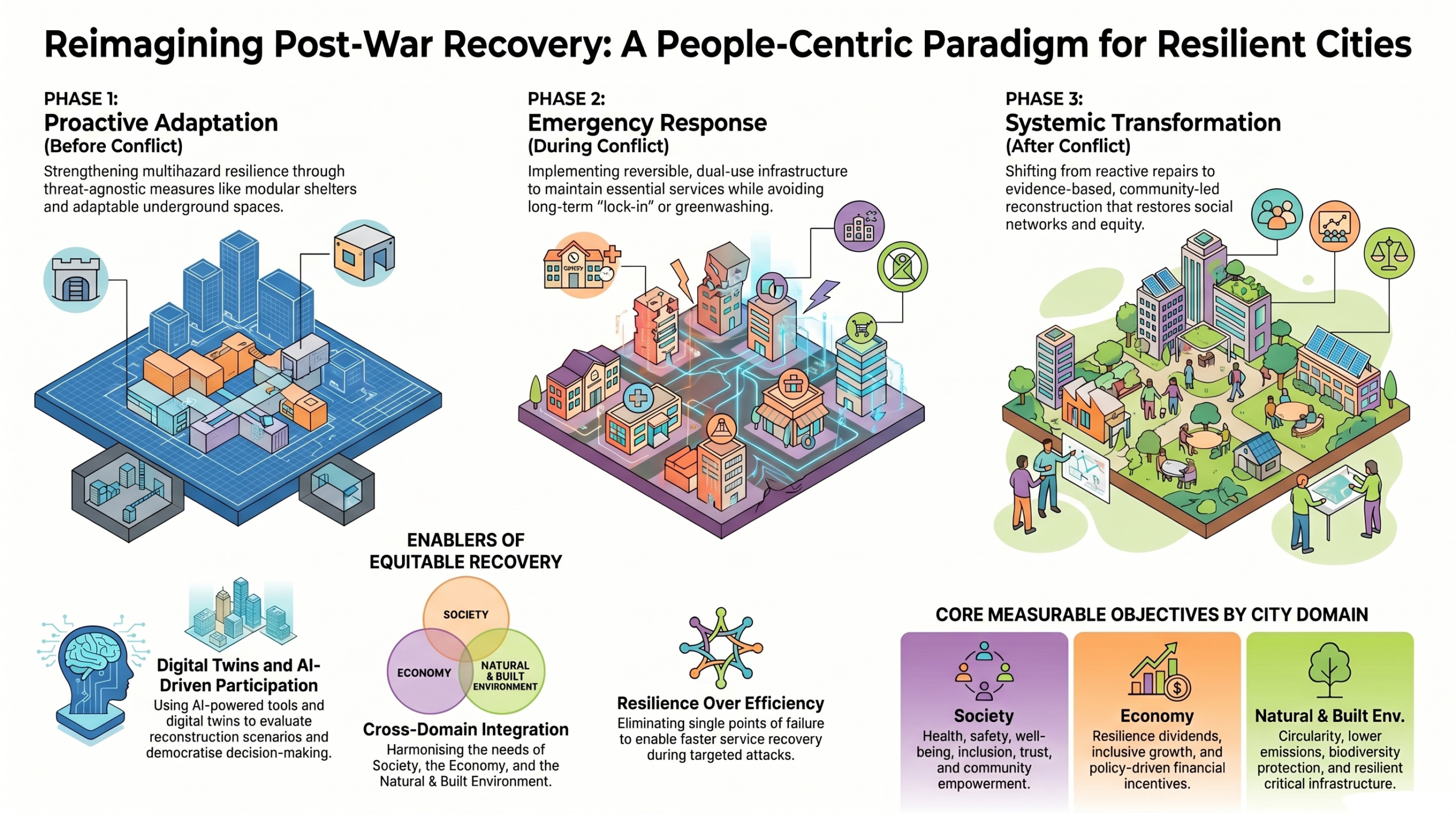
Simple summary
This paper explores a science-driven and people-centred approach to rebuilding cities after armed conflict. It explains why post-war recovery should go beyond physical reconstruction and address social justice, sustainability, civic trust, economic recovery and long-term resilience. The discussion highlights the role of AI, Digital Twins and advanced digital tools in supporting fairer, more transparent and community-informed recovery planning.
Key messages
- Post-war recovery must prioritise people, equity and resilience.
- Reconstruction should move beyond reactive, top-down rebuilding.
- Digital tools can support just and sustainable city recovery.
Podcast episode
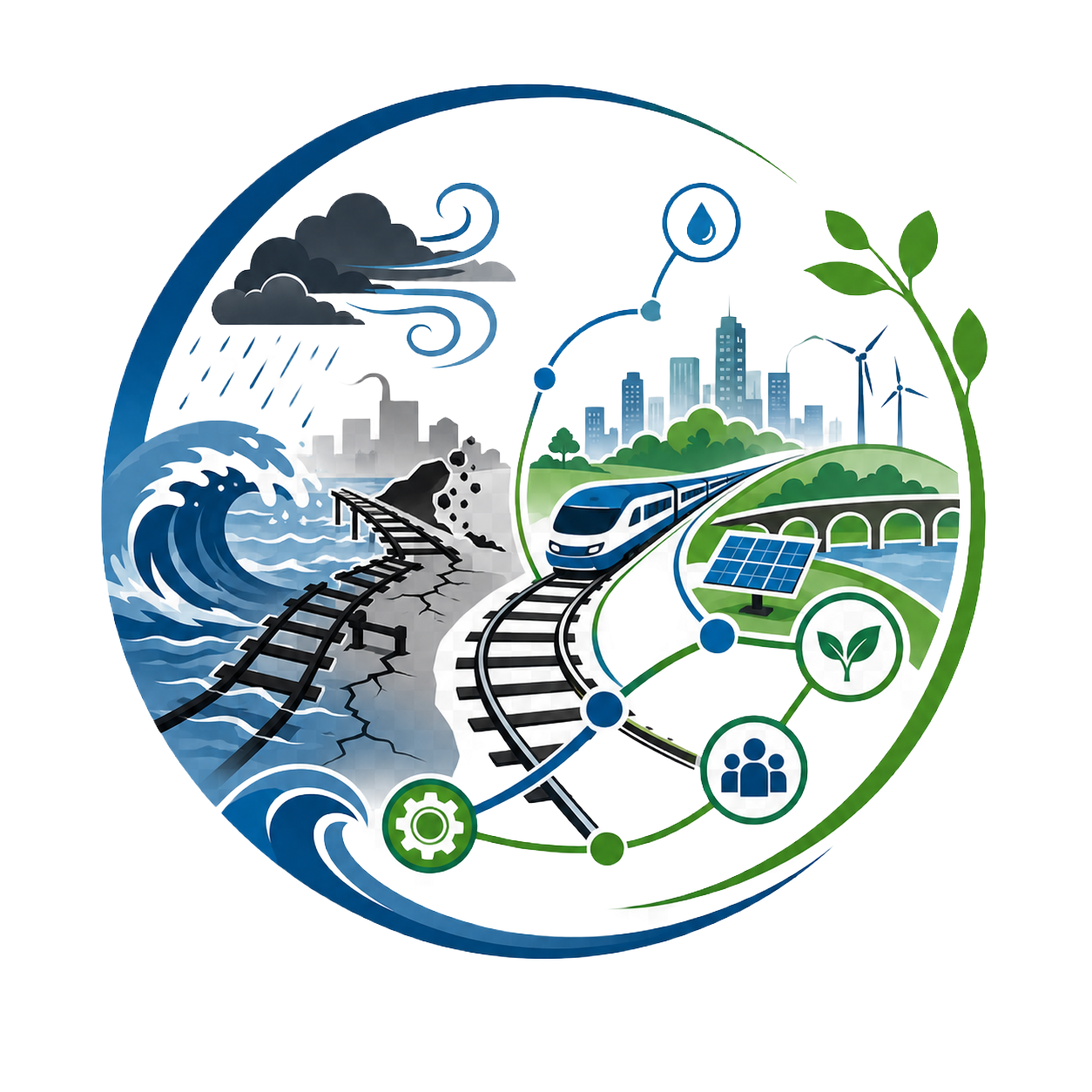
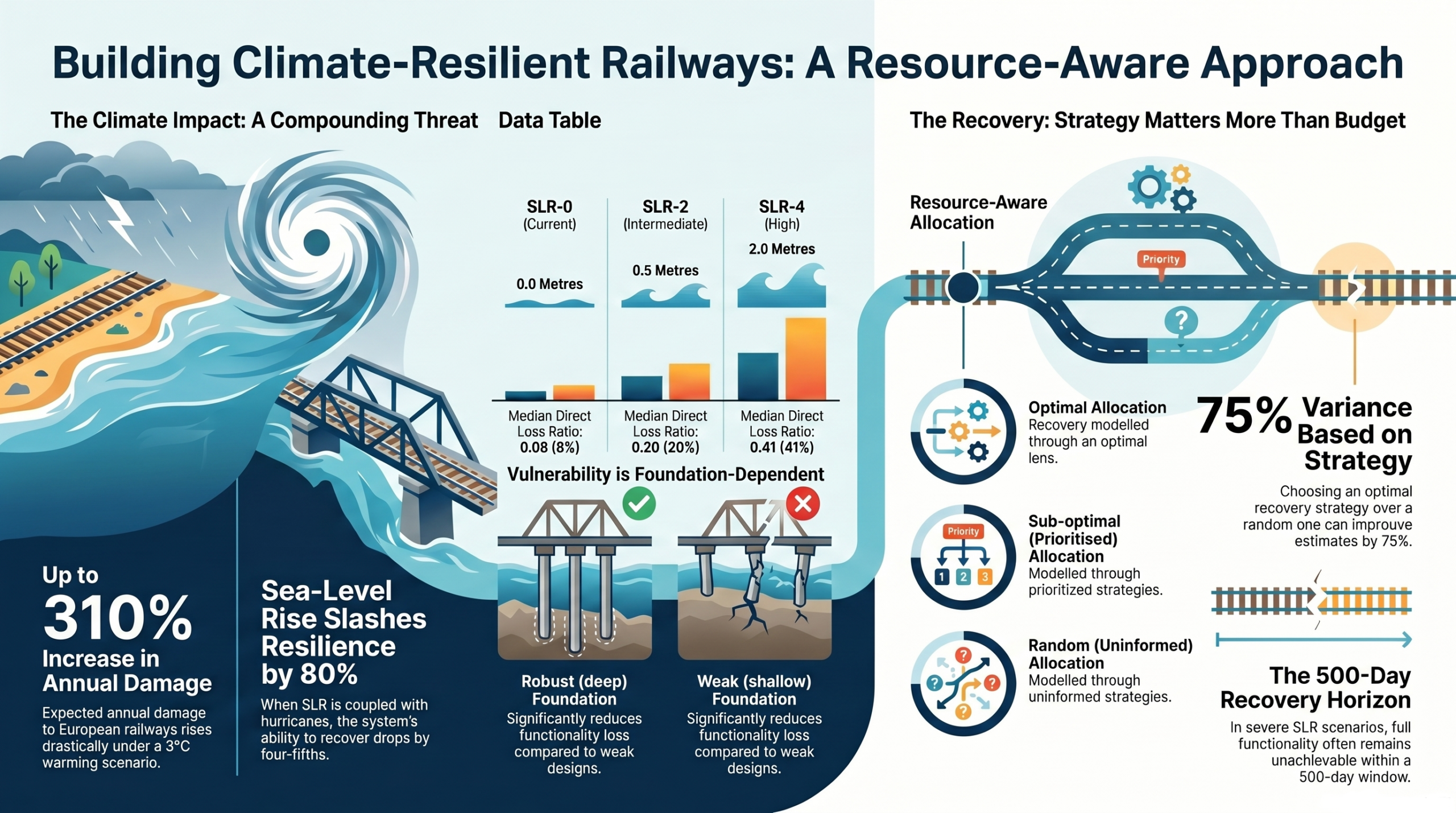
Climate-resilient railway networks: a resource-aware framework
Simple summary
This paper explores a probabilistic framework for assessing and improving railway network resilience under climate-driven hazards, including sea-level rise and hurricanes. Using the Alabama freight railway network as a case study, it explains how structural damage, limited recovery resources, repair priorities and decision-making strategies affect service restoration. The discussion highlights that strategic resource management is as important as physical infrastructure strength for protecting transport systems, supply chains and wider economic activity.
Key messages
- Climate change is increasing risks to railway networks.
- Resource allocation strongly shapes post-disaster recovery.
- Resilience planning must consider sea-level rise and uncertainty.
Podcast episode
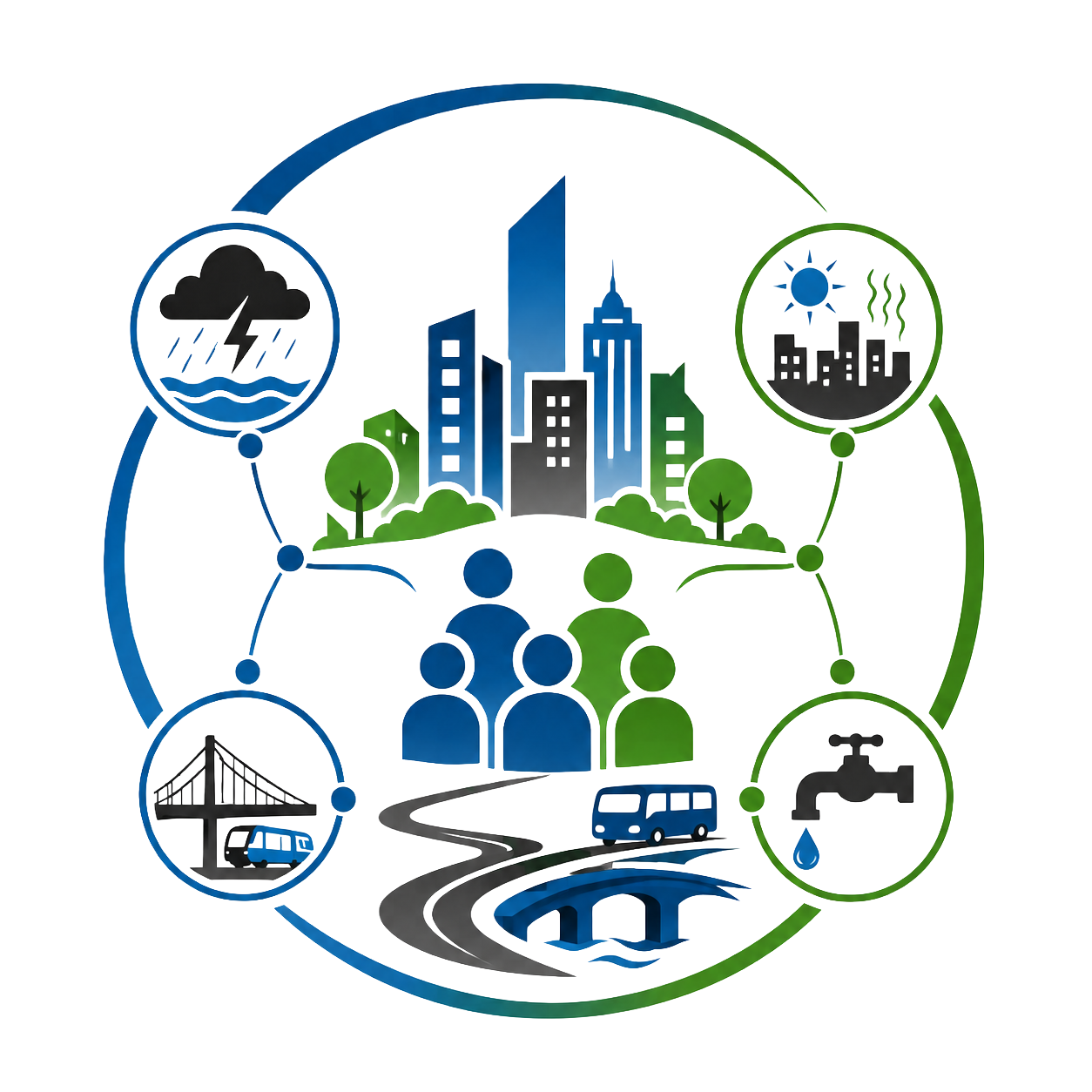
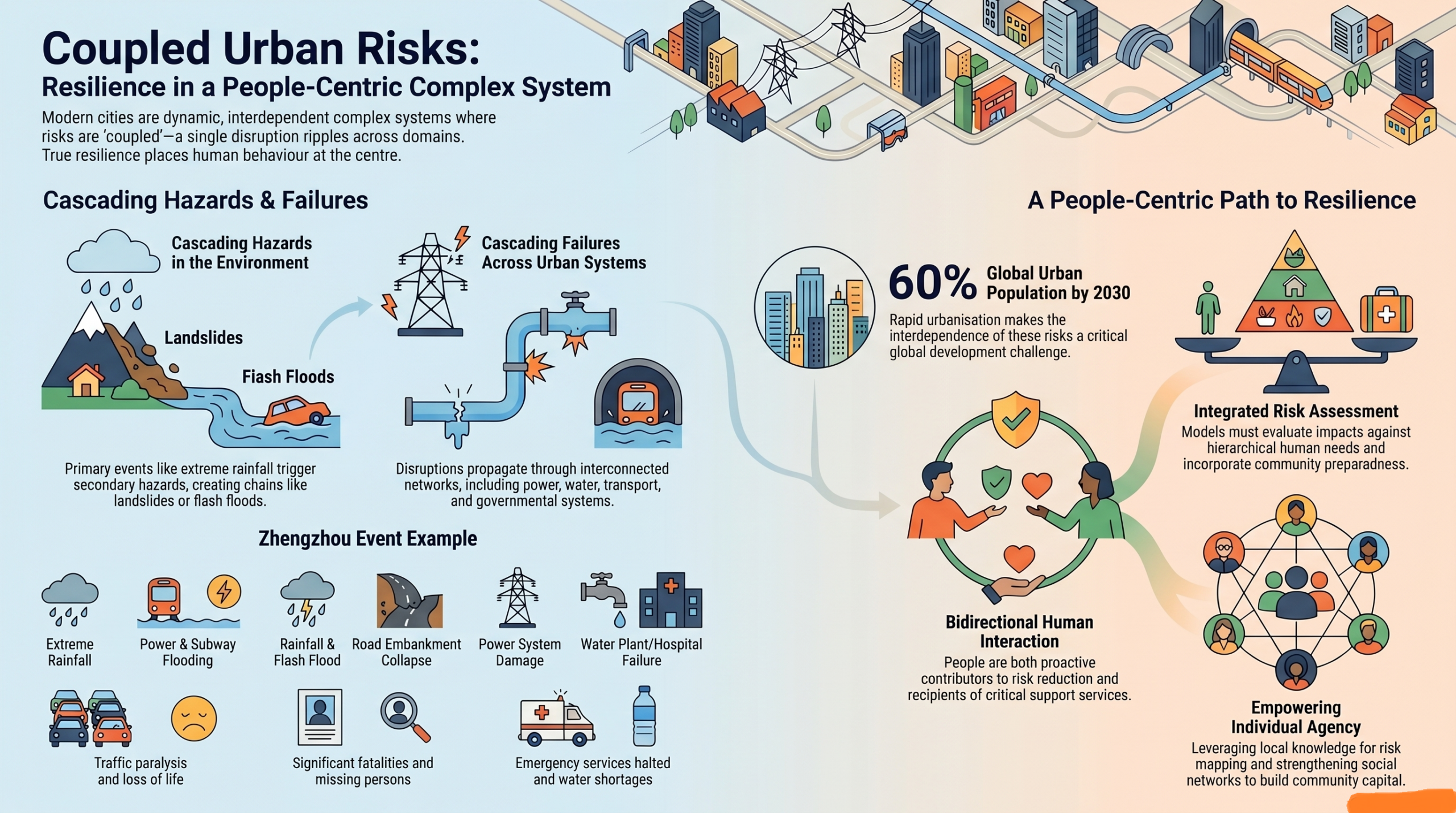
Coupled urban risks: a complex systems perspective with a people-centric focus
Simple summary
This paper explores how cities face coupled and cascading risks, where one hazard, such as extreme rainfall, can trigger failures across infrastructure, social and economic systems. It explains why urban risk assessment must go beyond physical assets and include human behaviour, decision-making and real-time interactions during crises. The discussion highlights the paper’s people-centric framework for improving resilience planning under climate change, rapid urbanisation and complex urban uncertainty.
Key messages
- Urban risks are interconnected and can cascade across systems.
- People’s behaviour shapes how risks evolve and are managed.
- Cities need people-centred and data-driven risk assessment.
Podcast episode
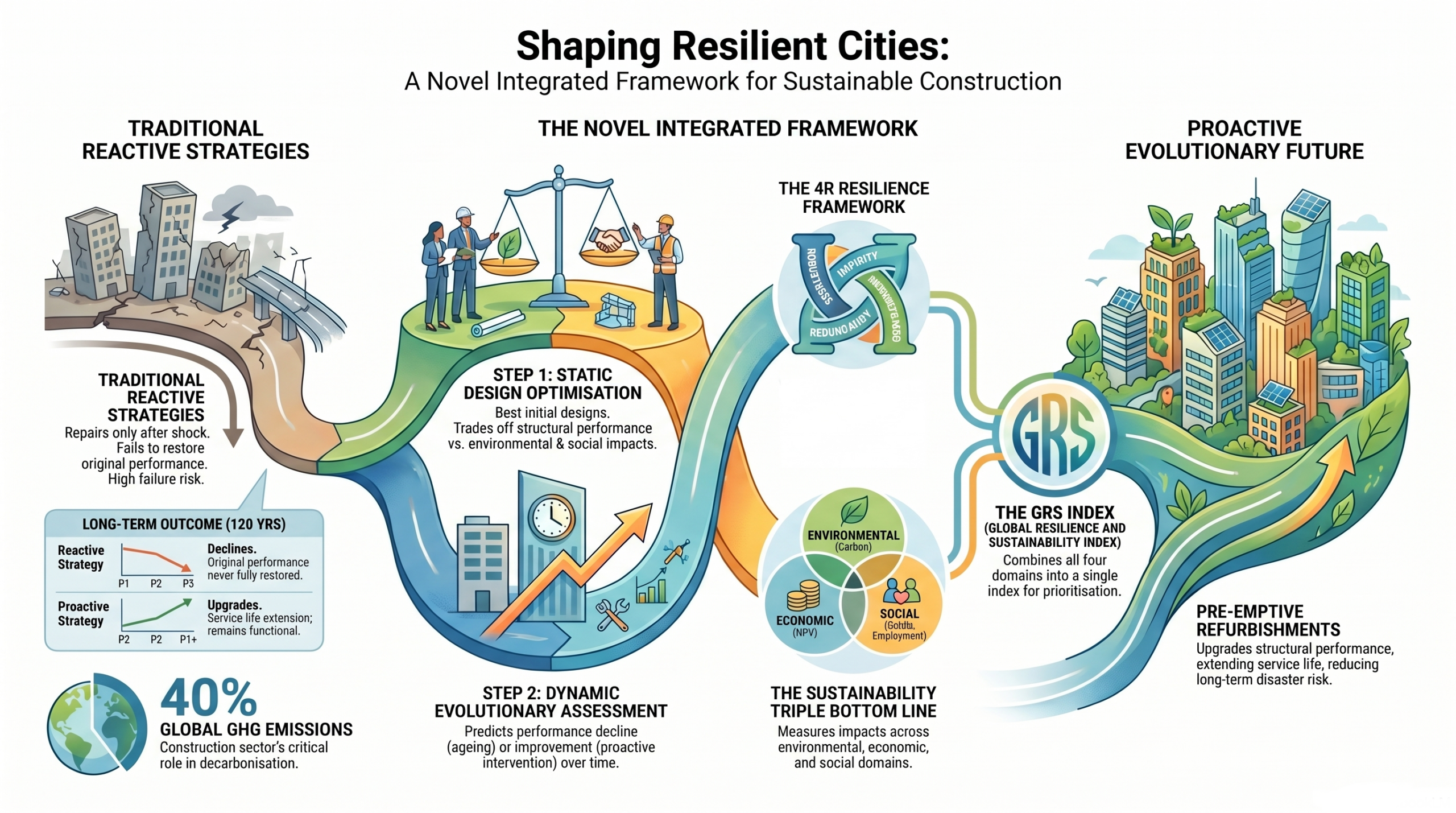
Enhancing sustainability and resilience against natural hazard of the built environment—state of the art and development of a novel framework
Simple summary
This paper explores how buildings and infrastructure can be assessed not only for structural safety, but also for environmental, economic and social performance across their life cycle. It explains why sustainability and resilience should be treated as connected but distinct concepts, especially as climate change increases exposure to natural hazards. The discussion highlights the paper’s review of current methods, key gaps in existing assessment approaches, and its proposed framework for supporting decisions on maintenance, repair, refurbishment and long-term adaptation of built systems.
Key messages
- Sustainability and resilience must be assessed together.
- Current methods overlook life-cycle social impacts.
- Proactive measures can reduce future hazard losses.
Podcast episode
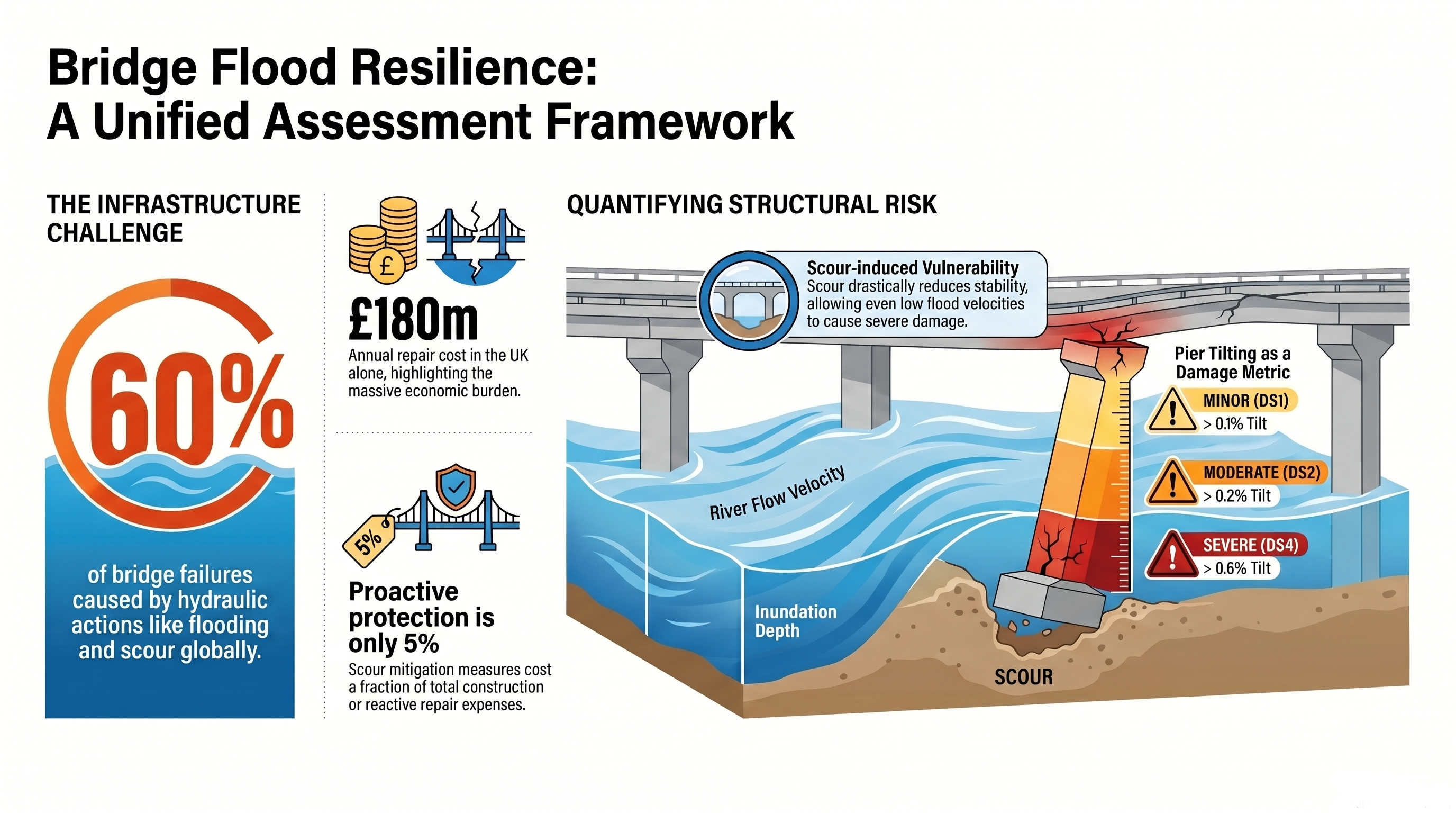
Flood fragility assessment of bridges—Unified framework
Simple summary
This paper explores a probabilistic framework for assessing bridge flood fragility, focusing on foundation scour, hydrodynamic forces, water velocity and inundation depth. It explains how the study uses numerical modelling, Monte Carlo simulations and flood analyses to evaluate bridge performance under extreme hydraulic events. The discussion highlights how scour can increase failure probability, particularly through pier tilting, and how the framework can support engineers and asset managers in adaptation planning and portfolio-level bridge risk assessment.
Key messages
- Bridge flood fragility can support risk-informed decisions.
- Scour strongly increases bridge vulnerability during floods.
- Proactive scour protection can reduce severe damage risk.
Podcast episode
Rapid post-disaster infrastructure damage characterisation using remote sensing and deep learning technologies: A tiered approach
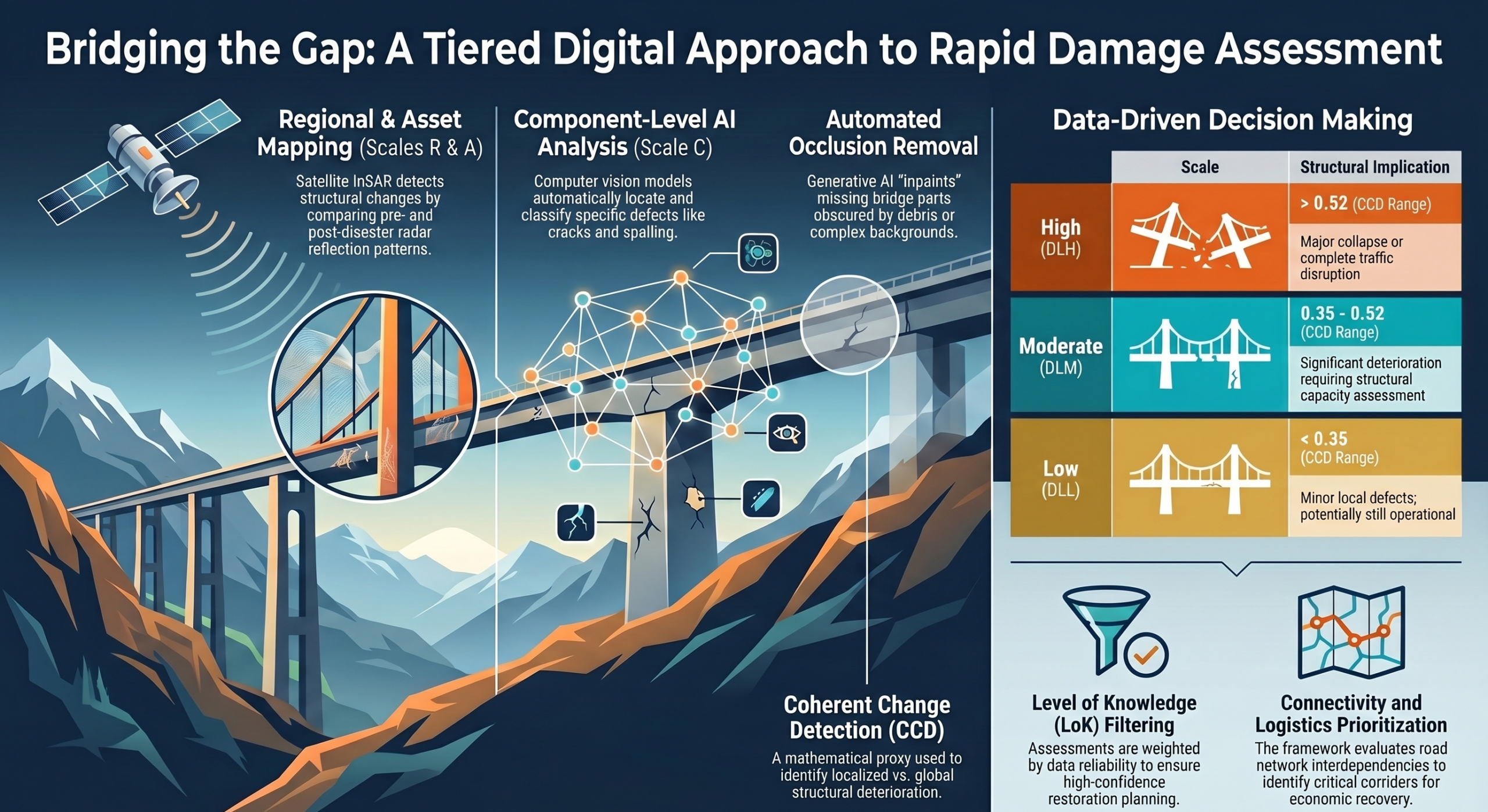
Simple summary
This paper explores a tiered framework for rapidly assessing post-disaster infrastructure damage using remote sensing, open-access data and deep learning. It explains how InSAR, high-resolution imagery, semantic segmentation and computer vision can support damage detection at regional, asset and component levels, especially when physical inspections are difficult or unsafe. Using damaged bridges along the Irpin River in Ukraine as a case study, the discussion highlights how digital technologies can accelerate restoration decisions, support transport network recovery and strengthen community resilience after disasters.
Key messages
- Rapid damage assessment is vital after disasters.
- Remote sensing and deep learning can detect infrastructure damage.
- Multi-scale digital assessment supports faster recovery decisions.
Podcast episode
Resilience models for tunnel recovery after earthquakes
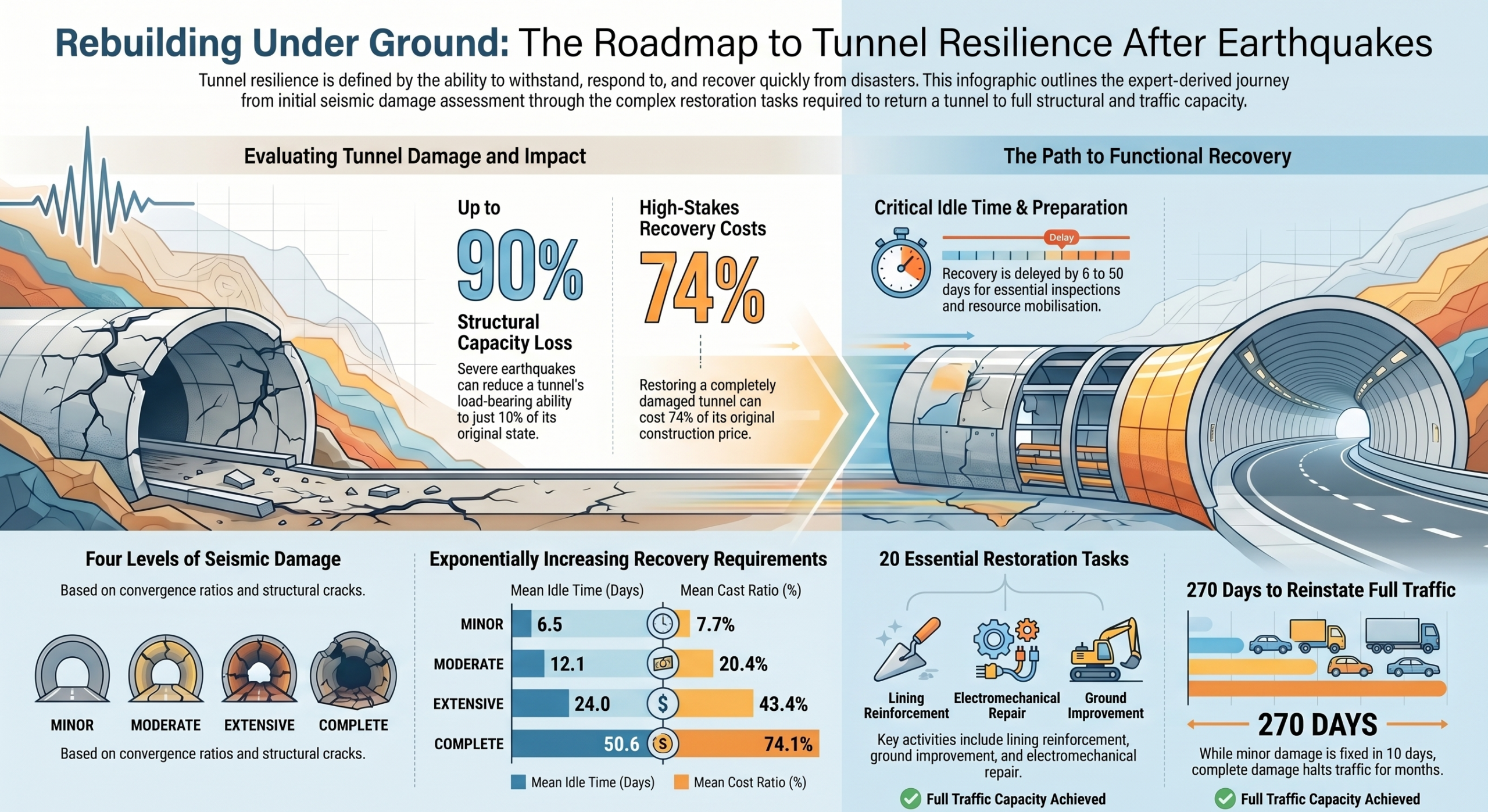
Simple summary
This paper explores how urban tunnels can recover after earthquake damage, focusing on both structural capacity and traffic functionality. It explains how the authors developed deterministic and probabilistic restoration models using expert-survey data on repair tasks, recovery duration, sequencing, idle time and costs. The discussion highlights the value of these models for infrastructure operators, city planners and decision-makers responsible for post-disaster recovery, resource allocation and resilient urban transport systems.
Key messages
- Tunnel recovery requires reliable restoration models.
- Damage-level models can quantify post-earthquake resilience.
- Expert-informed assessments support better investment decisions.
Podcast episode
Rethinking infrastructure design from component failure to systemic resilience
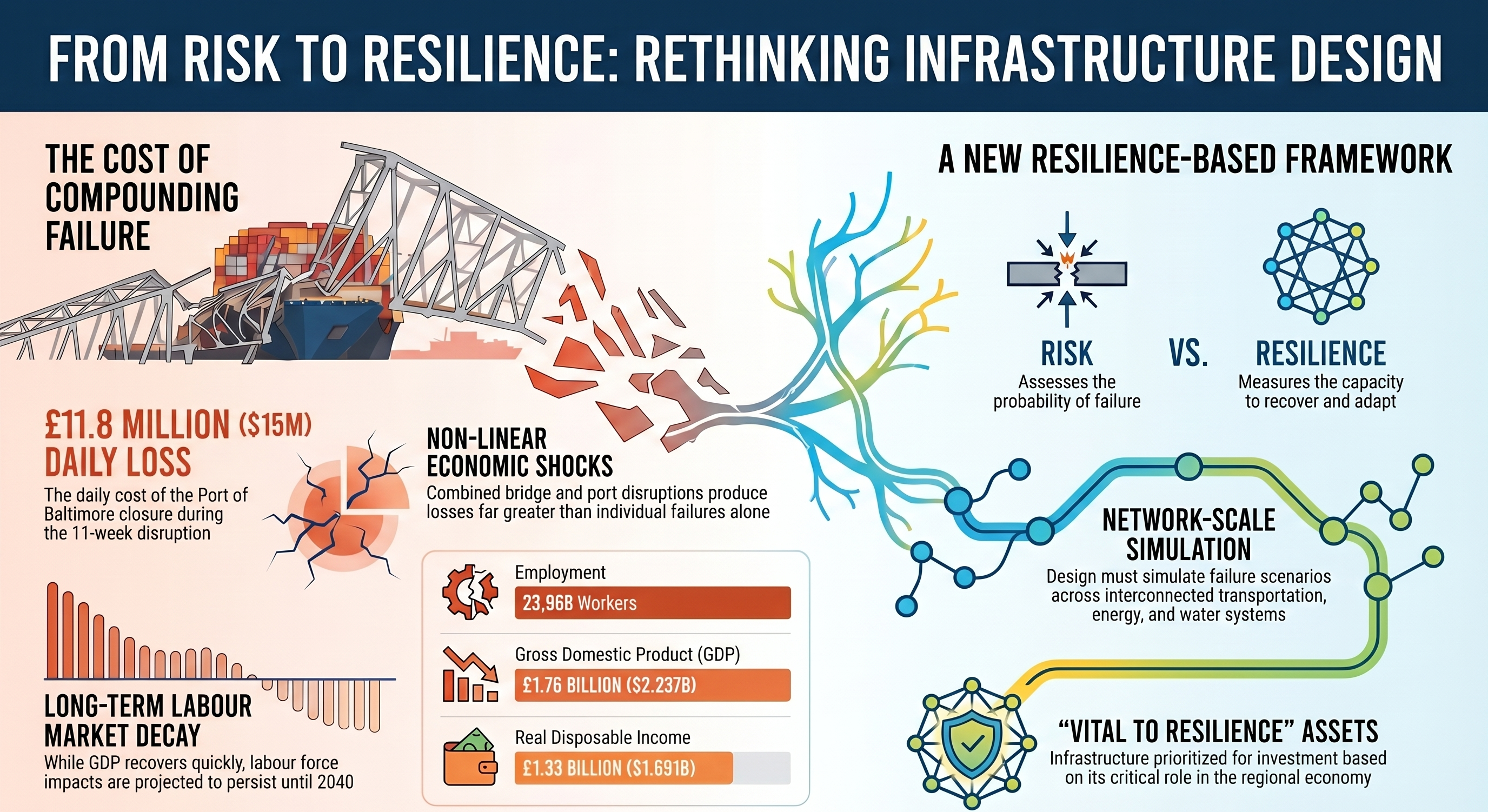
Simple summary
This paper explores why infrastructure design needs to move beyond isolated component failure and towards systemic resilience. Using the Francis Scott Key Bridge collapse as a key example, it explains how failures in critical assets can trigger wider economic, social and operational consequences through interdependent systems such as ports, transport networks and supply chains. The discussion highlights the need to assess infrastructure not only by structural integrity, but also by its geo-economic importance, cascading impacts, recovery capacity and long-term contribution to societal resilience.
Key messages
- Bridge design must consider system-level resilience.
- Infrastructure failures can trigger wider economic disruption.
- Cascading impacts should inform future design decisions.
Podcast episode
Roadmap: integrating artificial intelligence in structural health monitoring systems
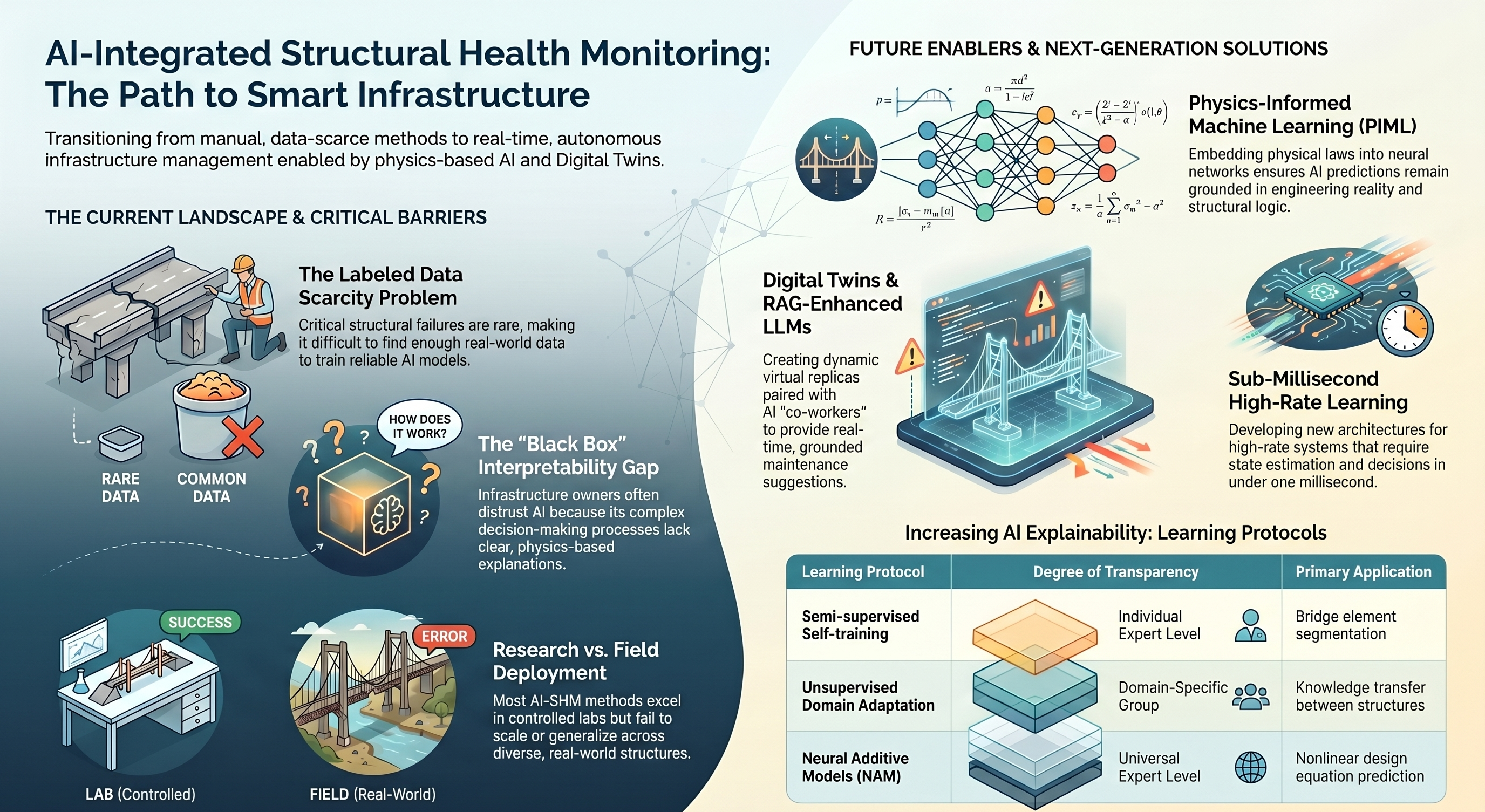
Simple summary
This paper explores how artificial intelligence can transform structural health monitoring by moving the field from traditional physics-based assessment towards data-driven, automated and predictive infrastructure management. It discusses how machine learning, digital twins, sensor networks and large language models can support damage detection, condition assessment and decision-making across civil, aerospace and mechanical engineering systems. The discussion also highlights the main barriers to real-world deployment, including limited labelled datasets, environmental variability, model interpretability, uncertainty quantification and the need for human-in-the-loop approaches. Ultimately, the paper presents a roadmap for integrating AI into structural health monitoring to improve safety, resilience, maintenance planning and the long-term performance of critical infrastructure.
Key messages
- AI can transform structural health monitoring systems.
- Trustworthy SHM needs data, transparency and validation.
- Digital twins can support scalable infrastructure assessment.